Dentures & Implants
Living With Dentures: Eating, Cleaning, Sore Spots and Relines
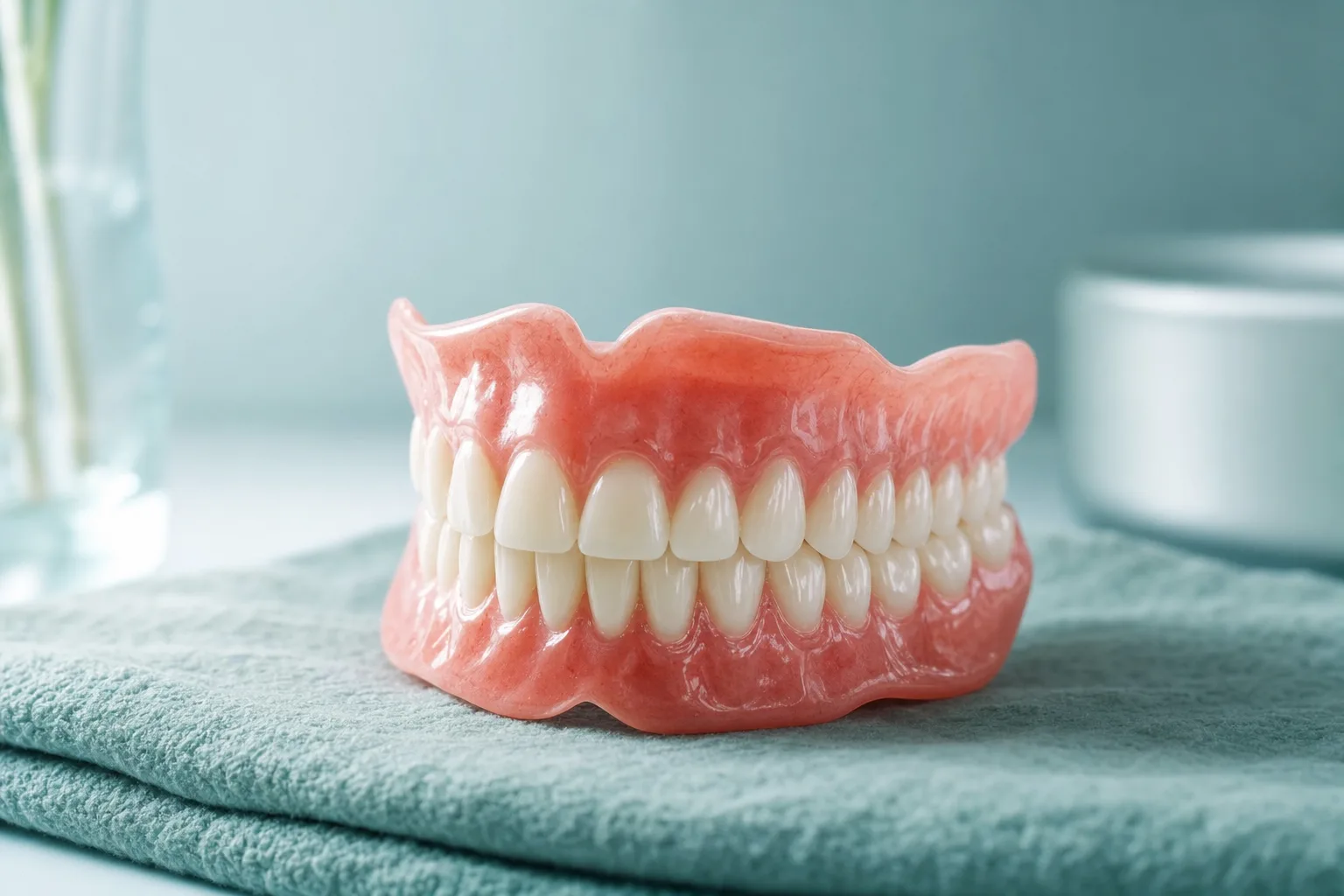
The first two weeks with a new denture are the hardest two weeks. Extra saliva, a lisp on your S sounds, a mouth that feels crowded, and at least one sore spot somewhere along the ridge — that is the normal arc, not evidence that something went wrong.
What matters is knowing where the line falls between soreness you push through and soreness that means the appliance needs adjusting. Here is that line, plus what to eat while you get there.
How long do new dentures hurt, and when is a sore spot a fit problem?
Short answer: Most people adapt to a new denture over roughly two to four weeks, with soreness peaking in the first several days and easing steadily after. A spot that stays in one exact location, worsens instead of fading, or breaks the tissue open is a pressure point. That needs a short adjustment appointment, not more patience.
A new complete or partial denture is a foreign object resting on tissue that has never carried a load like this. Your brain reads it as food for the first few days, so saliva pours. Your tongue relearns where to sit. Muscles you have never consciously used start doing the work of holding a lower plate steady. All of that improves on a predictable curve.
The adaptation curve, roughly
- Days 1 to 3. Heavy saliva, a full-feeling mouth, changed speech, and with an upper denture sometimes a gag reflex. True sore spots usually have not appeared yet — tissue needs a few days of chewing before it shows where the pressure lands.
- Days 4 to 10. Sore spots arrive. This is when nearly everyone comes back for the first adjustment. One visit is typical; two or three is common and does not mean the denture is bad.
- Weeks 2 to 4. Speech normalizes, saliva settles down, chewing gets measurably more efficient. The lower stays harder to manage than the upper. That is anatomy — a lower plate has a fraction of the surface area to grip and a tongue moving underneath it — not workmanship.
- Months 1 to 6 after extractions. Swelling resolves and the bone underneath remodels. An immediate denture placed the same day your teeth came out will loosen during this window. The reline that follows is planned, not a failure.
One practical thing that saves you a second trip: wear the denture for several hours before an adjustment appointment, even if it hurts. The pressure point has to be visible in the tissue to be marked and relieved accurately. Arriving after two days without the appliance means your dentist is guessing at where to grind.
Normal adaptation vs. a fit problem you should not wait out
| What you notice | What it usually means | What to do |
|---|---|---|
| Diffuse ache across the whole ridge, worse by evening, a little better each day | Normal loading of tissue that is not used to it | Keep wearing it; warm salt-water rinses; give it a week |
| One tender spot in the same exact place every time, sore to a fingertip | A pressure point on the denture border or fitting surface | Book an adjustment — usually a few minutes of chairside relief |
| An open ulcer with a pale base and a red rim | The tissue has already broken down | Be seen. Leave the denture out where you can, except for the hours before the visit |
| The upper drops when you laugh, talk or yawn | Border extension or seal problem | Adjustment; adhesive is a stopgap, not the fix |
| The lower rocks front to back when you bite | Bite balance or an unstable fitting surface | Adjustment; do not compensate by chewing on one side |
| Cracking and soreness at the corners of your mouth | Often bite height, sometimes a fungal component | Be seen; it rarely resolves on its own |
| A red patch on the palate shaped like the denture, sometimes burning | Denture stomatitis — commonly linked to wearing it overnight | Be seen; the routine below is most of the treatment |
Here is what happens if you decide to tough out a genuine pressure point. Constant trauma in one place produces a traumatic ulcer, and months of it can produce denture-induced hyperplasia, an overgrown fold of tissue along the denture border that sometimes has to be removed surgically before a new appliance will seat properly. Adjustments are quick. The alternative is not.
What can I eat with dentures? A 30-day progression
Two techniques matter more than any food list. First, load food onto your back teeth and bite there rather than with your front teeth. Biting into a sandwich or an apple with denture incisors levers the back of the appliance down and off the ridge, which is why so many people conclude their denture is loose when what they have is a technique problem. Cut, place, then chew. Second, chew on both sides at once. A denture is one rigid unit, and chewing only on the right tips the left side loose.
Week 1: nothing that has to be bitten or torn
Everything soft, everything lukewarm. An upper denture covers the palate, and the palate is where you sense heat — soup that feels fine on your lips can scald the roof of your mouth before you register it. Cool caldo down further than you think you need to for the first month.
Realistic week-one food: caldo cooled to warm with the vegetables mashed, licuados, avena, scrambled eggs, refried or mashed beans, mashed potato, yogurt, applesauce, well-cooked calabacitas, flan or pudding, soft cheeses.
Week 2: soft solids you can mash with a fork
Arroz blando, well-cooked pasta, flaked fish, picadillo or any ground meat in sauce, tamales off the husk, cooked carrots, queso fresco, ripe banana and melon, and soft tortilla torn into pieces rather than bitten off.
Weeks 3 and 4: firmer textures, still cut small
Shredded or diced chicken, sautéed vegetables, soft bread with the crust taken off, cooked nopales, eggs any style, whole beans, ripe fruit sliced off the core. If something makes the denture shift, drop back a week and try again in a few days. Adaptation is not linear.
After the first month
Most food comes back, with three permanent habits: cut instead of bite, steer around anything sticky, and stay honest about what your appliance can and cannot do.
What stays off the menu — conventional denture vs. overdenture
| Food | Conventional full denture | Removable overdenture on implants |
|---|---|---|
| Corn on the cob, ribs, anything eaten off the bone | Avoid — the front-tooth pull unseats it | Cut it off first; manageable that way |
| Whole apples, raw carrots, hard raw vegetables | Slice thin; biting in is out | Slice and chew on the back teeth |
| Carne asada, steak, chewy crust, bagels | Often frustrating even cut small | Usually workable when cut small |
| Caramel, chicle, taffy, sticky candy | Avoid — it lifts the base | Avoid — it also stresses the attachments |
| Popcorn kernels, sesame and chia seeds, small nuts | Avoid — they wedge under the base and are genuinely painful | Same problem; the base still rests on tissue |
| Very hot liquids | Cool them; the palate is insulated | Lower-only overdenture leaves the palate uncovered |
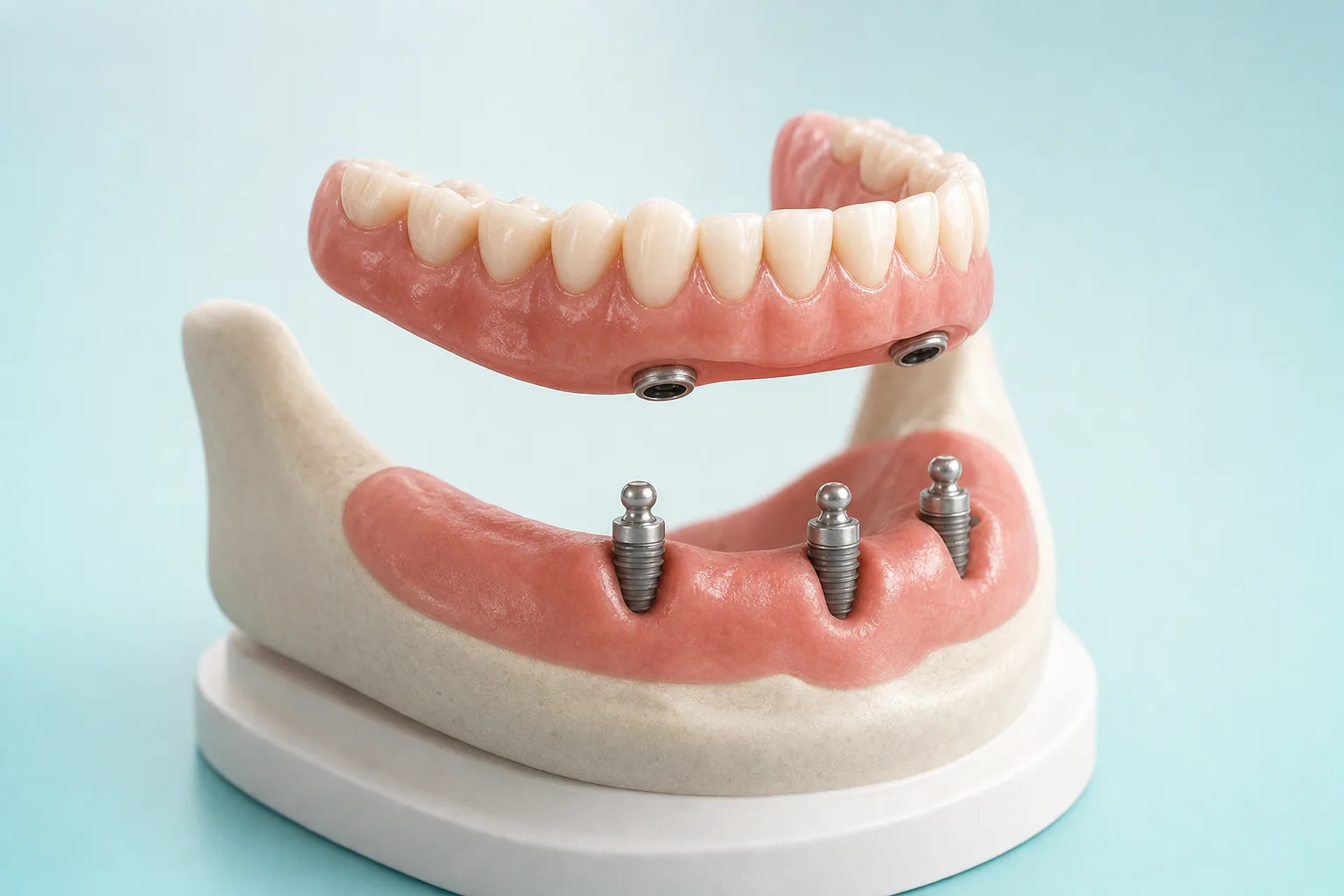
The honest framing: a removable overdenture retained by implants is far more stable than a conventional lower plate, and chewing usually improves a great deal. It is still an appliance that rests partly on tissue and comes out for cleaning. It is not a fixed set of teeth, and anyone describing it that way is overselling. Our page on overdentures secured by four implants explains how the retention actually works.
How to clean a denture without ruining it
- Rinse after meals. Take it out, rinse under cool water, rinse your mouth too. This alone prevents a large share of sore spots.
- Brush it once a day — with the right thing. A soft denture brush plus mild dish soap or a denture cleanser. Not regular toothpaste. Toothpaste abrasives are designed for enamel and they cut microscopic scratches into acrylic, and those scratches hold plaque and stain permanently.
- Fill the sink with water first, or lay down a folded towel. Dentures shatter on porcelain, and a drop into an empty sink is one of the most common ways a denture ends up in pieces.
- Cool or lukewarm water only. Hot water warps acrylic, and a warped base never fits the ridge again.
- Soak overnight in water or a denture solution. A dry base can distort. Rinse it thoroughly before it goes back in your mouth — soaking solutions are not meant to be swallowed.
- Brush your gums, tongue and palate every morning with a soft toothbrush before the denture goes in. It stimulates the tissue and cuts the bacterial load that causes stomatitis.
- No bleach on anything with metal. Household bleach corrodes and discolors partial denture clasps. Skip abrasive cleansers entirely.
The American Dental Association's patient library at MouthHealthy gives the same core guidance, and it is worth reading alongside whatever your denture's manufacturer supplies. If the appliance cracks, chips a tooth or stops seating, our repair and reline page covers what can be fixed and how quickly.
How do I clean the implants underneath a removable overdenture?
Almost every denture-care guide stops at the appliance. If you wear an overdenture, half the maintenance is what stays in your mouth after the denture comes out.
The abutments — the small posts screwed into the implants — sit above the gumline with a collar of tissue around each one. Plaque builds on them exactly as it does on natural teeth, and the gum around an implant is less forgiving than gum around a tooth. Nightly, with the denture out:
- Brush each abutment on all sides with a soft toothbrush, including the underside where it meets the gum.
- Wrap floss around the post in a C shape and shine it side to side, or use an interdental brush sized to fit. A water flosser on a low setting reaches what a brush misses.
- Brush inside the denture too. The nylon inserts sit in metal housings in the acrylic, and those recesses collect debris that never gets rinsed out.
- Look at the tissue while you do it. Firm and pink is right. Bleeding when you brush means inflammation — peri-implant mucositis, which is reversible when caught early and turns into bone loss when it is not.
Bleeding around an abutment that persists for more than a week or two is a reason to be seen, not a reason to brush harder. Keep your hygiene appointments as well; the professional side of this is covered on our cleanings page, and our post on keeping implants healthy long term goes deeper into peri-implant disease.
Can I sleep with snap-in dentures in?
No. Take them out overnight, and that answer does not change because there are implants underneath.
An acrylic base held against the palate all night traps plaque and yeast against tissue with no saliva flow to clear it. That is the setup for denture stomatitis: a red, sometimes burning inflammation shaped like the denture itself. Overnight wear is one of the best-documented risk factors for it, and the fix is largely mechanical — the appliance out, the tissue brushed, the denture cleaned and soaked.
Two honest footnotes. First, immediately after extractions your dentist may tell you to leave an immediate denture in for the first 24 to 48 hours, because it acts as a bandage over the surgical sites. Follow that instruction; it is deliberate and temporary. Second, if there are nights you genuinely cannot be without the appliance, make sure it gets several hours out during the day instead and never skip the cleaning routine. Sleeping in an overdenture also adds eight hours of load on the nylon inserts, which wears them out considerably faster.
Do the snaps wear out, and how often are they replaced?
Yes, and they are designed to. The retention in a snap-in overdenture comes from a small nylon or plastic insert seated in a metal housing inside the denture, not from the metal post in your jaw. The insert is the sacrificial part — it is meant to wear so that the implant does not take the abuse.
Published replacement intervals disagree with each other, and pretending otherwise would be false precision. Some sources describe changing inserts every six to twelve months; others report them lasting a couple of years or longer. What actually drives the number:
- How often you take it in and out. Every insertion and removal cycle is wear.
- Bite force and clenching. Heavy chewers and night grinders go through inserts faster.
- Implant angulation. Posts that are not close to parallel scrape the inserts on every seating. This is decided at surgery and you inherit it for the life of the case.
- Whether you sleep in it. See above.
- Hygiene. Grit and calculus inside the housings act like sandpaper.
Signs yours are finished: the click softens or disappears, one side lifts when you chew, food starts working its way underneath, or you catch yourself pressing the denture back down through the day. Replacement is a short chairside visit — the worn insert is lifted out of the housing and a fresh one seated. Inserts also come in different retention strengths, so if your denture is either too tight to remove comfortably or too loose to trust, that is adjustable rather than permanent.
Ask about this cost before you start treatment, not after. Recurring maintenance is a real part of owning an overdenture and a written estimate should account for it. If you are weighing the options, our comparison of implants against conventional dentures lays out the trade-offs, and our team can tell you what your PPO, HMO, Denti-Cal or Medi-Cal plan covers — the details are on our insurance page.
Relines, rebases and when a denture needs replacing
The bone that supports a denture keeps shrinking. Resorption is fastest in the first six months after extractions and then slows to a steady annual loss that never entirely stops. Your denture does not change shape. The ridge underneath it does, which is why a plate that fit beautifully two years ago now rocks.
A reline refits the fitting surface to the ridge as it is today. Immediate dentures commonly need one within the first several months. After that, complete dentures are relined periodically — often on the order of every couple of years — and eventually replaced when the teeth wear flat or the base can no longer be refitted usefully. Overdentures need relines too; the base still rests on tissue between the implants.
Two things to avoid. Drugstore reline kits set hard against a ridge that is still changing, lock in a fit that was wrong the day it cured, and often have to be ground out before a proper reline can be done. And adhesive is a bridge, not a repair: using a little while you wait for an appointment is reasonable, needing steadily more of it month over month is the signal that the fit has drifted and you should come in.
Come in now, or wait it out?
Call the office now: an open sore that has not started healing within a week; a sore spot that returns in the same place after an adjustment; a denture that rocks, drops or clicks against the ridge; a red or burning palate; a cracked base or a chipped denture tooth; bleeding around an implant abutment that keeps recurring; a snap that no longer holds.
Reasonable to wait a few days: generalized ridge soreness in the first week; extra saliva; a temporary lisp; a mild gag reflex that is already improving; food occasionally getting underneath in the first month while your technique settles.
Get seen urgently if… your face or jaw swells, you develop a fever, swallowing becomes difficult, or an area of your mouth goes numb. And any sore, white patch or red patch that has not healed after two weeks — particularly on the tongue, the floor of the mouth or under the denture — needs to be examined rather than watched. Trouble breathing or swallowing is an emergency room visit, not an appointment.
Questions worth asking at your next denture visit
- Is this soreness a pressure point I should have relieved, or normal loading?
- When should this denture be relined, and how will I know it is time?
- If I have an overdenture, how many attachment inserts does it use, and what does a replacement visit involve?
- What is realistic for me to chew with this appliance six months from now?
If your denture is sore, loose or clicking
Most denture complaints are fixable in one short appointment, and waiting rarely improves them. Dr. Sameer Aljanedi and our bilingual team in Downey handle adjustments, relines and repairs — se habla español. Book a visit or call (562) 928-5559 and bring the denture with you.
Have questions about your smile?
Dr. Sameer Aljanedi and the team at Rio Hondo Dental Office are here to help. Se habla español.