Implants & Restorative
Dental Crowns
A crown caps a damaged tooth and takes over the work of chewing. It is what a tooth needs when a filling has nothing left to hold onto, or when a crack means the tooth has to be held together rather than wedged apart every time you bite.
Se habla español · Serving Downey, Pico Rivera, South Gate, Bellflower & nearby
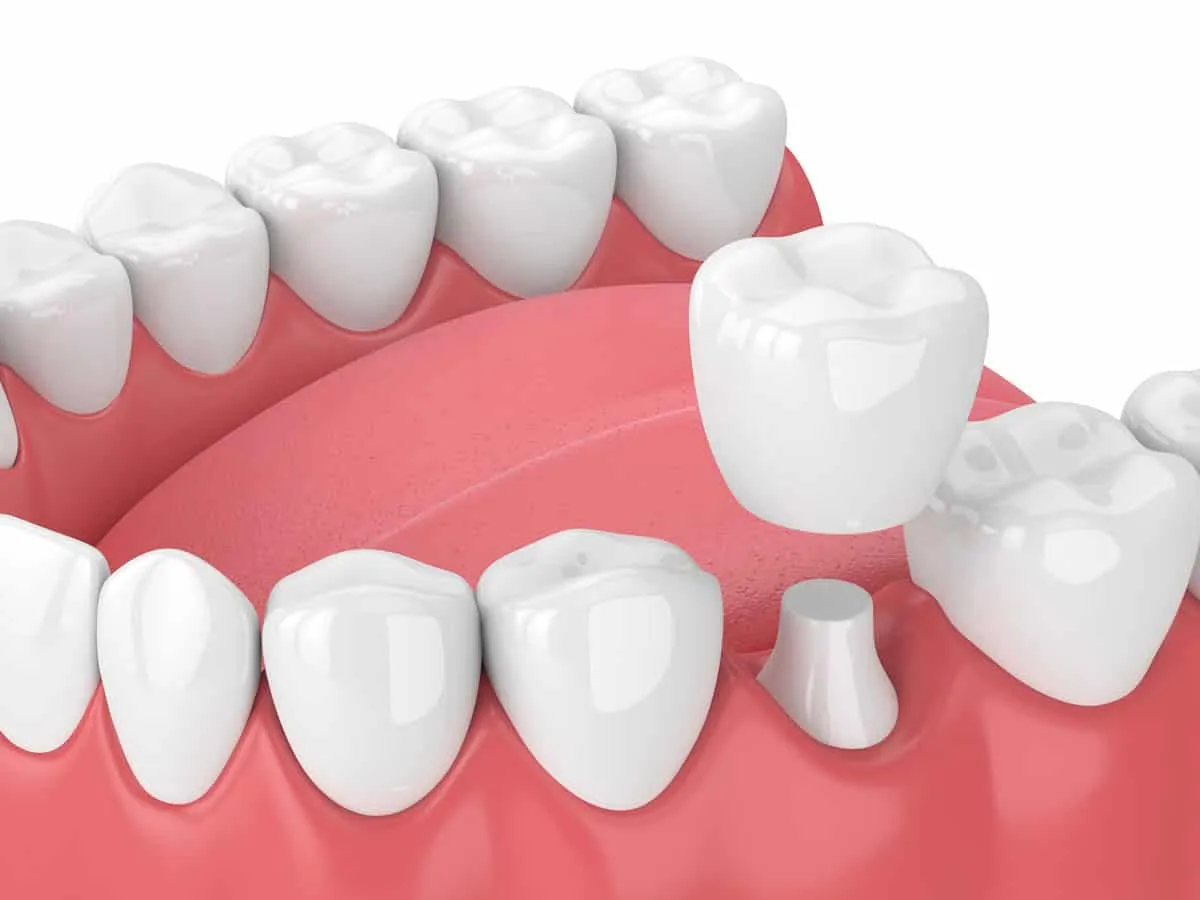
A crown covers the whole chewing surface and sides of a tooth, replacing its outer shell. Dentists reach for one when a tooth has lost too much structure to hold another filling, or when it is cracked and needs to be squeezed together rather than split apart every time you bite down.
What a dental crown actually does
Short answer: A dental crown is a custom cap cemented over a prepared tooth to replace its outer shell. It restores chewing strength, holds a cracked or heavily filled tooth together, and rebuilds the tooth's shape and color. Most crowns take two visits with a temporary in between, and a well-made crown commonly lasts ten to fifteen years or more.
The real difference between a filling and a crown is the direction of force. A filling sits inside the tooth and depends on the walls around it staying intact. A crown wraps the outside, so biting force compresses the tooth instead of levering it apart. That is why a molar with a hairline crack often settles down within days of being crowned — the flexing stops.
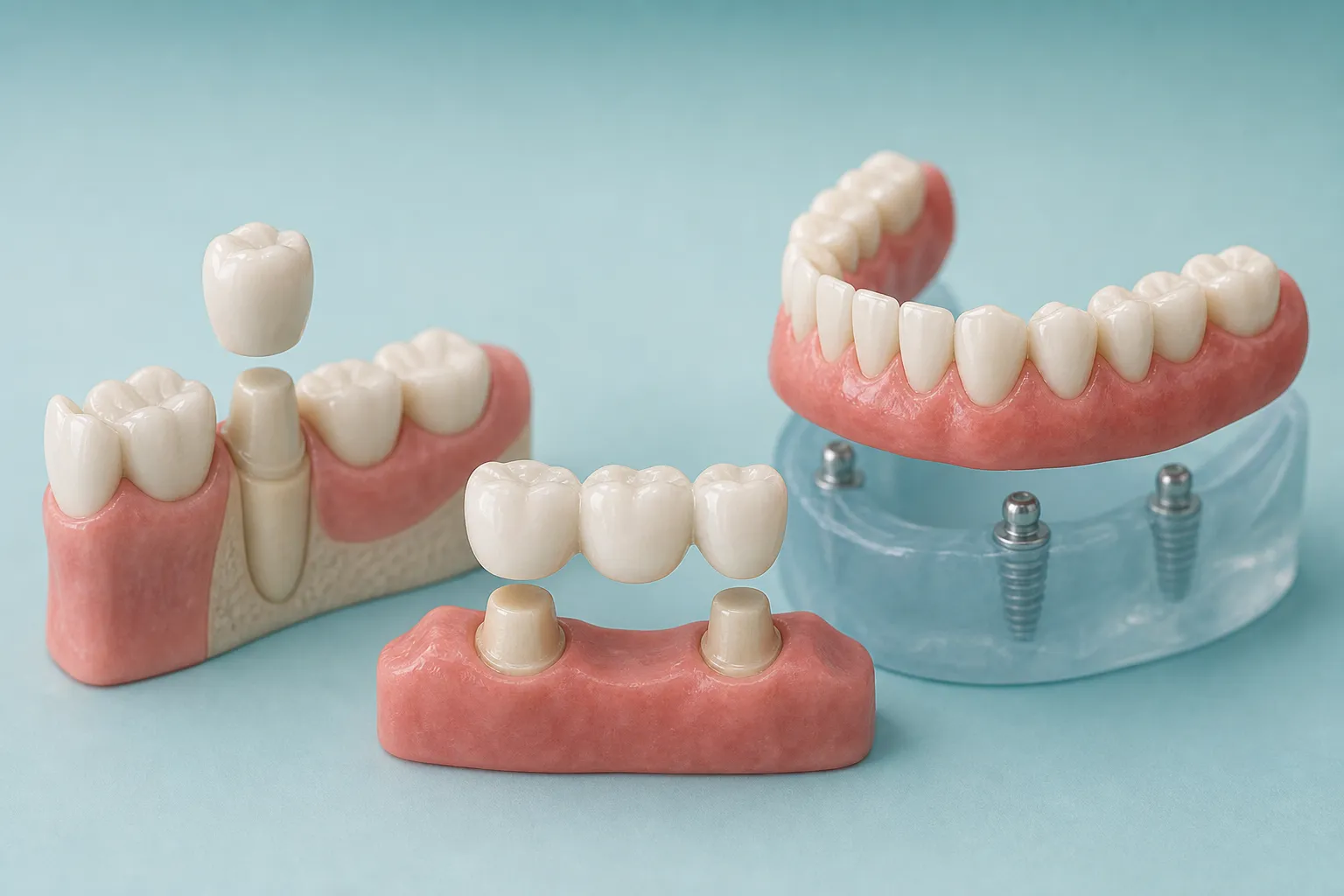
Crowns also cap things that are not natural teeth: the abutment on a dental implant, or the supporting teeth at each end of a dental bridge. Same shape, same materials, different foundation underneath.
Signs a tooth needs a crown, not another filling
- More than roughly half the biting surface is filling rather than tooth, and the edges keep chipping away.
- A cusp — one of the pointed corners — is undermined or has already broken off.
- The tooth hurts when you release pressure after biting. That is the classic cracked-tooth sign, and hairline cracks are often invisible on an X-ray.
- The tooth has had root canal treatment, especially a back tooth, which is more brittle afterward than it looks.
- Decay runs under the contact point where the tooth meets its neighbor, leaving no wall to build a filling against.
None of that means rushing. If nothing is broken and nothing hurts, ask for the reasoning: how many walls remain, whether a crack line crosses the floor of the preparation, what happens if you choose the cheaper repair. Our guide to deciding between a crown and a filling walks through the same criteria a dentist applies, and after a fracture, crown versus onlay versus veneer compares the middle-ground options. For most small and medium cavities, a composite filling is still the right answer.
What the two visits are really like
- Numbing and shaping, 60 to 90 minutes. The tooth is numbed, old filling material and decay come out, and the tooth is reduced by roughly a millimetre to a millimetre and a half on each surface to make room for the crown. If a lot of tooth is gone, a build-up is bonded first so the crown has something to grip.
- The scan or impression. A digital scan or a putty impression records the prepared tooth, the neighboring teeth and how your bite closes.
- Temporary crown. A temporary goes on with soft cement so it lifts off easily later. It is not as strong as the finished crown, and it is not meant to be.
- Two to three weeks at the laboratory while the crown is made.
- The fit visit, 20 to 40 minutes. The temporary comes off, the crown is tried in, contacts and bite are checked, and it is cemented. Anesthetic often is not needed, though it is there if the tooth is sensitive.
Living with the temporary is straightforward: chew on the other side, skip gum and caramel, and pull floss out sideways instead of snapping it up past the margin — that is how most temporaries come off. If yours does come off, keep it and call us the same day. A prepared tooth left uncovered can drift within days, and then the finished crown will not seat.
If dental work makes you tense, say so when you book. Local anesthetic handles the prep appointment, and sedation options are available for patients who need more than that.
How long crowns last, and what actually breaks them
Ten to fifteen years is the honest working figure, and plenty of crowns outlast it. Published follow-up studies of single crowns describe the pattern more precisely: high survival through the first five years, with failures accumulating slowly after that. The porcelain is rarely the problem. The tooth underneath usually is.
| Material | Commonly reported survival | Where it tends to be used | Trade-off |
|---|---|---|---|
| Metal-ceramic (porcelain fused to metal) | Roughly 90–95% at 10 years in long-running series | Back teeth, bridge units | Porcelain can chip; a dark metal margin may show if gums recede |
| Monolithic zirconia | Mid-90s percent at 5 years; longer-term data still accumulating | Molars, heavy grinders | Very strong but less translucent, and hard to adjust or drill through later |
| Glass-ceramic (lithium disilicate and similar) | High on front teeth; more fractures reported on molars in older data | Front teeth and premolars | Best appearance, least forgiving of clenching |
| Full gold or high-noble alloy | The longest track record of any crown material | Molars outside the smile line | Appearance is the only real drawback; gentle on opposing teeth |
These ranges are what the dental literature reports across large groups of patients — not a prediction for one tooth, and not a statement of what any particular office stocks. Which material suits your tooth depends on its position, your bite and your budget.
Four things shorten a crown's life, and every one of them is in your hands:
- Grinding and clenching. Bruxism cracks porcelain and works cement loose. Sore jaw muscles in the morning, or a partner who hears the grinding, is reason enough for a custom night guard — cheap next to a replacement crown.
- Flossing everything except the crown. The margin, that seam where crown meets tooth, is precisely where decay starts. It needs floss carried all the way to the gum, once a day. The American Dental Association's consumer site, MouthHealthy, makes the same point: a crowned tooth still needs daily cleaning at the gumline.
- Gum disease. As gum and bone recede, the margin ends up sitting on root surface, which decays faster than enamel. Treating gum disease protects the foundation the crown is standing on.
- Ignoring a crown that feels loose or catches food. A crown with a broken seal leaks. Saliva and bacteria get underneath and the tooth can rot quietly for months behind an intact-looking cap.
Add the obvious hazards while you are at it: ice, popcorn kernels, hard candy, and using teeth to open packaging. Crowns are strong. They are not indestructible.
My new crown hurts when I bite — what that usually means
Nine times out of ten the crown is a hair too tall. Your bite lands on that one tooth first, the ligament around the root gets bruised, and it aches on chewing. This is the most common complaint after cementation and the easiest thing to fix: a few minutes with articulating paper and a polishing bur, no anesthetic needed. Do not wait weeks hoping it settles — a tooth taking the whole bite can become genuinely painful.
Cold sensitivity is a different animal and usually normal. The tooth has been worked on and the nerve takes time to quiet down. Give it about two weeks. What is not normal: pain that lingers 30 seconds or more after something cold, throbbing that wakes you at night, or discomfort that builds instead of fading. Those point to the nerve, and the fix is generally root canal treatment carried out through the crown, which does not usually mean replacing it.
Get seen urgently if… your face or gum swells, you run a fever, the tooth throbs constantly or wakes you at night, or you cannot bite on it at all. Swelling around a tooth is an infection looking for somewhere to go, and it will not resolve on its own. Call (562) 928-5559 or see our emergency dental care page for what to do in the meantime.
Can a crown get a cavity?
The crown cannot decay. The tooth under it absolutely can, and recurrent decay at the margin is the single most common reason a crown has to be redone. It starts at that seam, tracks under the cap where a toothbrush has never reached, and frequently causes no pain at all — particularly on a root-canal-treated tooth with no nerve left to complain. It normally shows on a routine bitewing X-ray long before you feel anything, which is the argument for keeping up cleanings and checkups even when nothing hurts.
About the dark line people notice at the gumline: it is usually not decay. On a metal-based crown it is the metal substructure showing through thin gum tissue, or the gum having receded a millimetre to expose the darker root surface below the porcelain. Worth showing your dentist; not worth losing sleep over. Decay at a margin looks different — a chalky or brown notch you can catch with a fingernail, or floss that shreds in the same spot every single time.
What drives the price of a crown
Two crowns in the same mouth can carry different fees, and the reasons are structural rather than cosmetic:
- What has to happen first. A build-up or post to replace missing tooth structure, root canal treatment, or crown lengthening when decay runs below the gum are separate procedures with separate fees.
- Material and laboratory. Different materials carry different lab costs, and a shade-matched front tooth takes more laboratory time than a molar nobody sees.
- What the crown sits on. A crown restoring an implant includes an abutment; a crown anchoring a bridge is quoted per unit.
- Timing. A tooth crowned before it fractures is one procedure. A tooth that splits below the gum often cannot be saved at all, and then you are pricing extraction and replacement instead.
On the insurance side, plans commonly treat crowns as a major service: they pay a percentage rather than the full fee, and waiting periods, annual maximums and alternate-benefit clauses all come into play. Our breakdown of crown coverage under PPO and HMO plans explains how to read your benefits before you commit to treatment.
We take most PPO and HMO plans along with Denti-Cal and Medi-Cal. Coverage for crowns under those programs is subject to program rules and frequency limits, and what applies to a back tooth is not always what applies to a front one, so we verify your specific eligibility and put a written estimate in your hands before any work starts. If a gap is left over, CareCredit, Cherry and Sunbit can spread it across months.
The drawbacks nobody mentions up front
Preparing a tooth for a crown is not reversible. Enamel comes off all the way around, and that tooth will need a crown for the rest of its life. In a minority of cases the nerve does not tolerate the combination of deep decay and preparation, and dies months or even years later — reported rates vary widely depending on how damaged the tooth was to begin with — which means root canal treatment on a tooth you thought was finished with.
Porcelain also does not bleach. If whitening is anywhere on your list, do it first, let the shade settle for a couple of weeks, then match the crown to the lighter color. Reversing that order means paying for the crown twice.
Five questions worth asking before you agree
- How many walls of this tooth are left, and what happens if we fill it instead?
- Is a partial-coverage onlay an option here, or does the whole tooth need covering?
- Does this tooth need root canal treatment first — and how likely is it to need one later?
- What else is on the written estimate besides the crown: build-up, post, temporary?
- What does my plan pay, and what is left for me?
Any dentist should be able to answer all five without hesitating.
If a tooth is cracked, tender on chewing, or held together by an old filling that keeps breaking, have it looked at before it splits. Request a visit with Dr. Sameer Aljanedi in Downey or call (562) 928-5559. New patients are welcome, and se habla español.
FAQ
Frequently asked questions
What is a dental crown and when do I need one?
A crown is a custom cap cemented over a prepared tooth to replace its outer shell. It is used when too little sound tooth remains to hold a filling, when a tooth is cracked and flexes under biting force, after root canal treatment on a back tooth, and to restore a dental implant or anchor a bridge.
How many visits does a crown take, and does it hurt?
Usually two. The first shapes the tooth and records a scan or impression; the second seats the finished crown, generally two to three weeks later. A temporary protects the tooth in between. The preparation is done under local anesthetic, so you should feel pressure rather than pain, and sedation is available if you tense up in the chair.
How long do dental crowns last?
Ten to fifteen years is a fair working figure, and many last longer. Long-term follow-up studies of single crowns report high survival through the first five years, with losses accumulating slowly after that. Crowns are rarely lost because the porcelain failed; they are lost because the tooth underneath decayed, the nerve died, or grinding cracked the restoration.
Why does my new crown hurt when I bite down?
Most often the crown is fractionally too tall, so your bite lands on that tooth first and bruises the ligament around the root. It is a quick chairside adjustment, not a redo. Cold sensitivity for a week or two is common. Pain that lingers 30 seconds after cold, throbs at night, or worsens over two weeks suggests the nerve, so call us rather than waiting.
Can you get a cavity under a crown?
The crown itself cannot decay, but the tooth beneath it can, and that is the most common reason a crown has to be replaced. Decay begins at the margin where crown meets tooth and often causes no symptoms at all, especially on a root-canal-treated tooth. Daily flossing to the gumline and routine X-rays catch it early.
How much does a dental crown cost?
The fee depends on what has to happen first (a build-up, a post, root canal treatment), the material and laboratory, which tooth is involved, and whether the crown sits on a natural tooth or an implant. We give a written estimate before treatment, accept most PPO and HMO plans plus Denti-Cal and Medi-Cal subject to program rules, and offer CareCredit, Cherry and Sunbit financing.