Implants & Restorative
Dental Implants
A titanium post replaces the root of a missing tooth; a custom crown replaces the rest. It is the only tooth replacement that keeps loading the jawbone instead of resting on top of it.
Se habla español · Serving Downey, Pico Rivera, South Gate, Bellflower & nearby
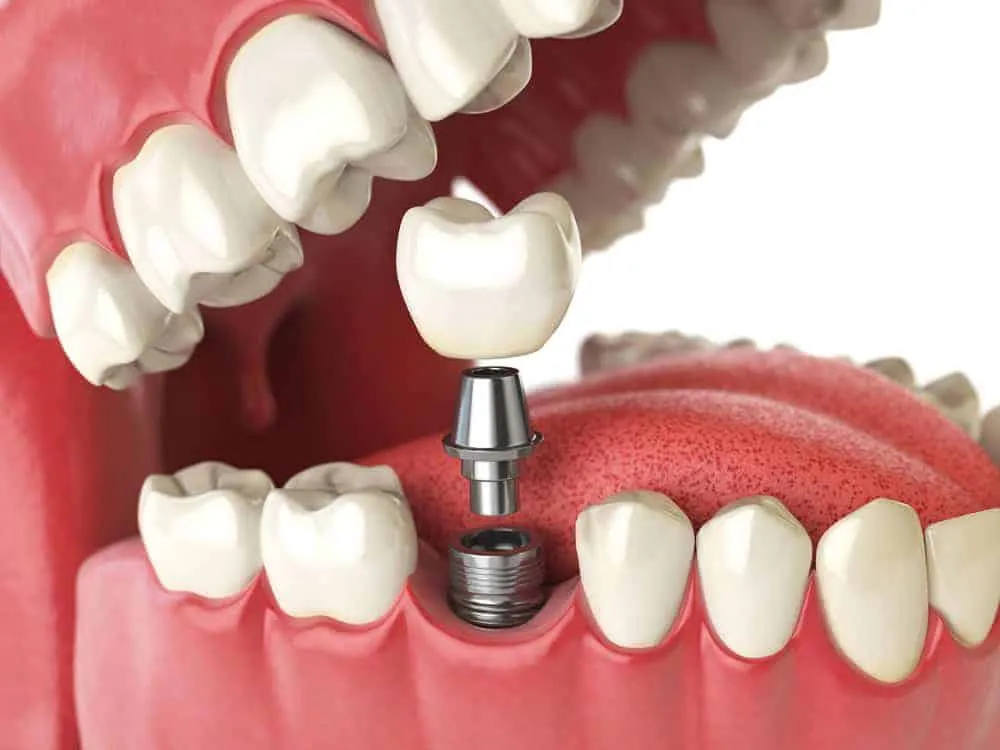
A missing back tooth rarely hurts, and that is exactly the problem. Nothing forces the decision, so months pass — and the bone that used to hold the root quietly narrows. An implant is the only replacement that puts a load back into that bone instead of resting on top of it.
What a dental implant actually is
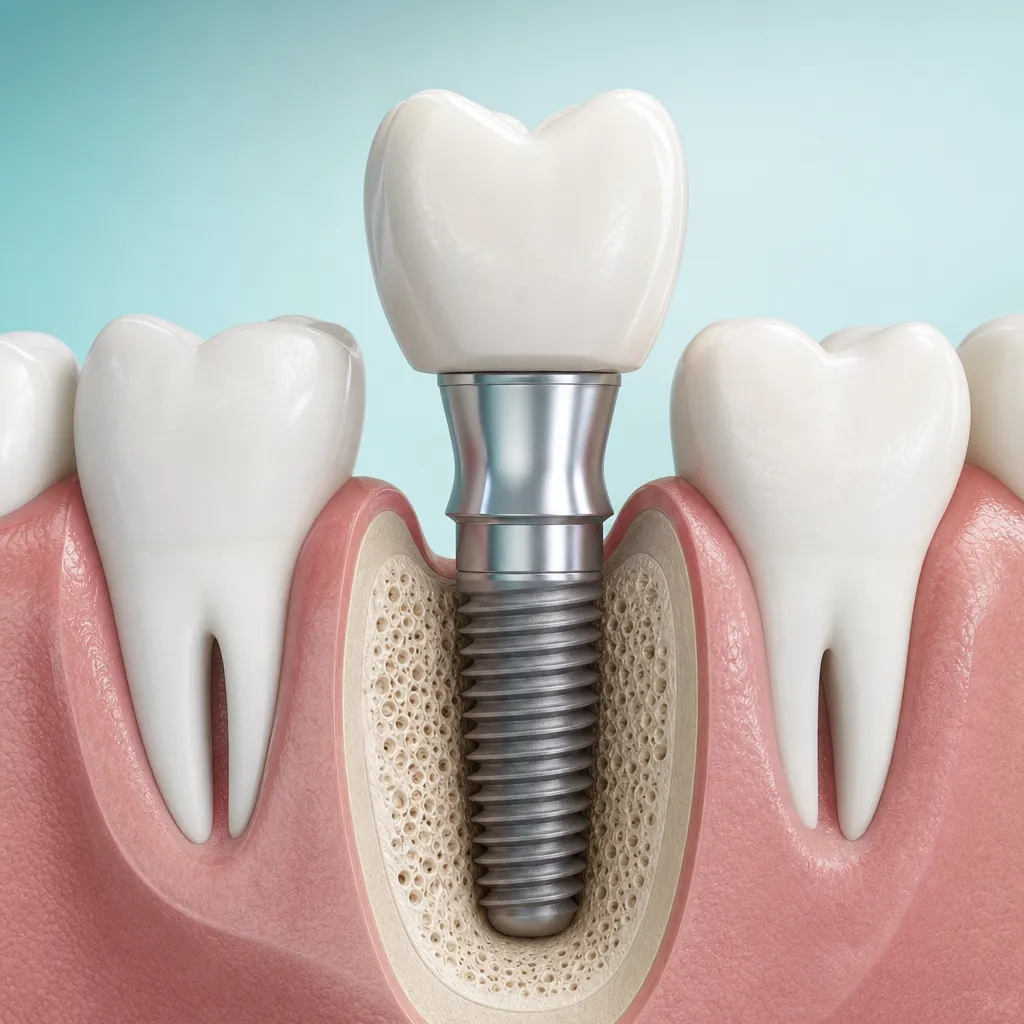
Short answer: A dental implant is a titanium post placed into the jawbone to take the place of a tooth root. An abutment connects it to a custom crown on top. Placement usually takes under an hour with local anesthetic, then the post fuses to the bone over roughly three to six months before the final tooth is attached. Most healthy adults with enough bone qualify.
Three separate parts, three separate lifespans. That matters, because when someone says their implant broke, they almost always mean the crown or a screw — not the post in the bone. The post is the surgical part and it is meant to stay; the crown on top is what you chew with, and it is replaceable. Still deciding between replacements? Our overview of ways to replace a missing tooth lays the choices side by side.
Who is a candidate, and what actually rules people out
Most adults in reasonable health qualify, and the conditions that genuinely rule someone out are narrower than most people assume. The screening has less to do with age than with three things: how much bone sits at the site, how healthy the gums are, and what is happening in the rest of your body while the site heals. Planning starts with a 3-D scan so the ridge can be measured for width as well as height, and so the nerve in the lower jaw and the sinus above the upper molars are mapped before anything goes in.
Usually straightforward
- Adequate bone at the site, or a graft that has already healed
- Gums free of active infection and bleeding
- Well-controlled diabetes, blood pressure or thyroid disease — control matters far more than the diagnosis
- Common blood thinners, which are usually managed rather than a reason to cancel. Never stop a prescribed medication on your own.
Fix this first, then place
- Active gum disease. The bacteria that dissolved bone around your natural teeth will do the same thing around an implant. Periodontal treatment comes first — no exceptions.
- A thin or collapsed ridge. Width usually disappears before height does. Bone grafting or a sinus lift can rebuild the site, which adds months but makes an impossible case possible.
- Heavy grinding. Clenching loads an implant in ways a natural tooth's ligament would absorb. A custom night guard is part of the treatment plan, not an upsell after the fact.
- Smoking or vaping. Slower healing and a measurably higher failure rate. It is not an automatic no, but cutting back around the surgery genuinely changes the odds.
- An infected tooth still in the socket. It comes out first, the socket is cleaned and often grafted the same day. See what extraction and socket preservation involves.
Where we may say no, or send you to your physician first
- Teenagers whose jaws are still growing. An implant does not move with growth, so a tooth placed too early ends up sitting lower than its neighbors years later.
- IV antiresorptive (bisphosphonate) therapy for cancer, or past radiation to the jaws. These need coordination with your physician and sometimes rule out surgery.
- Uncontrolled diabetes or an unmanaged immune condition during the healing window.
- Anyone who cannot commit to cleaning around it. Blunt, but implants are lost to neglect more often than to bad surgery.
The implant timeline, start to finish
- Consultation and 3-D scan. One visit: measurements, health history, a review of your medications, and a written plan you take home.
- Extraction and socket preservation, if the tooth is still there. Grafting the socket on the day the tooth comes out keeps the ridge from caving in. Roughly three to four months of healing.
- Ridge augmentation or sinus lift, when the site needs rebuilding. Adds about four to nine months before an implant can be placed, depending on how much has to be built back.
- Placement. Typically 45 to 90 minutes for a single implant under local anesthetic. Sedation options are available if the surgery itself is the part stopping you.
- Osseointegration. Three to six months while bone grows onto the post. Lower jaws often integrate faster than upper ones because the bone is denser.
- Uncovering and gum shaping. A healing abutment shapes the gum collar for two to three weeks so the crown emerges like a real tooth.
- Scan, then crown. The final tooth is made and fitted, usually two to four weeks after the digital scan or impression.
Add it up. A single implant into good bone commonly runs four to six months from placement to final crown. Start from a failing tooth that needs extraction and grafting first, and nine to eighteen months is honest. Our week-by-week healing guide walks through what each stage feels like.
Same-day implants: who really qualifies
Two different things get sold under that name. Immediate placement means the implant goes in the same day the tooth comes out. Immediate loading means a temporary tooth goes onto the implant the same day. The second one is what people picture, and it has real requirements:
- The implant has to be tight in the bone the moment it is placed. Surgeons call it primary stability; without it, the implant gets a healing cap and waits.
- No active infection or abscess at the site.
- Enough bone to hold the implant in the right position, not merely in some position.
- Systemic disease under control, and no heavy clenching or grinding.
- The temporary stays out of your bite. It is there for appearance and gum shaping, not for chewing steak.
Front teeth qualify more often than molars. And the honest translation of teeth in a day: you get a temporary in a day. The final restoration still arrives months later, once the bone has done its part.
What actually drives the cost
Two people can be quoted very different numbers for the same word and both quotes can be fair, because "an implant" covers anything from one post and one crown to a staged rebuild of an entire ridge. Before you compare two numbers, it helps to know what a complete implant estimate should itemize. These are the variables that move the total:
| Cost driver | Why it moves the number |
|---|---|
| How many implants | Each post is its own surgery, component set and healing period |
| Whether a tooth still has to come out | Extraction plus a socket graft is a separate procedure with its own materials and waiting time |
| Grafting | A small socket graft is a modest add-on; ridge augmentation or a sinus lift is a larger surgery with a longer wait |
| What goes on top | A single crown, an implant bridge spanning a gap, or an overdenture that snaps onto four implants are entirely different prosthetics |
| Abutment type | A stock abutment costs less than one milled to match your gum contour; front teeth more often need the custom version |
| Crown material | Zirconia, layered porcelain and metal-backed crowns are not priced alike |
| Sedation | Local anesthetic is part of the procedure; sedation is an added service billed by time |
| Imaging and guides | The 3-D scan, plus a surgical guide when the case calls for one |
| Your plan type | A PPO with an annual maximum, an HMO with a set fee schedule, or no insurance at all change your out-of-pocket far more than the fee itself does |
Fees vary by case. We quote in writing after the exam and scan, never before.
Ask for the estimate itemized. A complete one lists the surgical placement, the abutment, the crown, the 3-D scan, any graft material and membrane, sedation if used, the temporary, and which follow-up visits are included. If a quote is a single number with no breakdown, ask what is inside it — that is how patients discover their "implant" price did not include the tooth. Our guide to implant pricing and how PPO and HMO plans differ goes deeper. Payments can be spread through CareCredit, Cherry or Sunbit, and patients without insurance often do better on our in-house membership plan. If you are weighing treatment abroad against staying local, we compared implants in Mexico with treatment here, follow-up care included. If you are weighing treatment abroad against staying local, we compared implants in Mexico with treatment here, follow-up care included.
Denti-Cal and Medi-Cal cover a defined list of services, and implants are generally not part of routine adult coverage — though related care such as extractions or dentures may be, subject to program rules and frequency limits — we cover what the program does and does not put toward an implant separately. We verify your exact eligibility before treatment is scheduled; here is how we handle Denti-Cal, Medi-Cal and dental insurance.
How long each part lasts
"Implants last a lifetime" is half true, and the half nobody explains at the consultation is this: the post in the bone is the durable part, while everything attached to it is a serviceable component with a maintenance schedule.
| Component | What to expect | What shortens it |
|---|---|---|
| Titanium post | Once integrated, commonly decades — often the rest of your life | Peri-implantitis (infection of the gum and bone around it), smoking, uncontrolled diabetes |
| Abutment screw | Long-lived, but it can loosen; usually re-tightened rather than replaced | Heavy bite forces, grinding, or a crown left slightly high in the bite |
| Crown | Commonly ten to fifteen years or more | Chipped porcelain, wear, clenching |
| Overdenture attachments | The nylon inserts that grip the posts are wear items, replaced periodically — often every six to eighteen months | Snapping the denture in and out daily, which is normal use rather than damage |
| Denture base over implants | Relined every few years as the ridge underneath keeps changing | Ongoing bone remodeling under the prosthesis |
If you are replacing a full arch, budget for those attachment inserts the way you budget for tires. They are inexpensive and routine — but conventional dentures have no such part, so the ongoing maintenance catches people off guard.
What recovery really feels like
Most patients are surprised by how ordinary it is. A single implant is generally an easier recovery than the extraction that preceded it.
- The day of surgery. Numb for three to five hours. Light oozing is normal and firm gauze pressure handles it. No rinsing, no straws, no smoking. Start ice early — twenty minutes on, twenty off.
- Days 1 to 3. Swelling peaks somewhere around 48 to 72 hours and then turns the corner. Most people manage with ibuprofen and acetaminophen. Bruising along the jaw or cheek can appear on day two and looks worse than it is.
- Days 4 to 7. Soreness fades to tenderness. Soft foods, chew on the other side, warm salt-water rinses instead of vigorous swishing.
- Week 2. Sutures dissolve or come out. Normal routine for most people, still keeping hard chewing off the site.
- Months 3 to 6. Nothing to feel at all. The wait is bone biology, and there is no way to hurry it.
Grafting changes that picture. A sinus lift or a block graft is a bigger recovery than the implant itself — more swelling, more restrictions, and instructions about nose-blowing that actually matter. Read what bone graft recovery is really like before you agree to one.
Get seen urgently if… pain increases after day three instead of easing, swelling spreads toward your eye or down your neck, swallowing or breathing becomes difficult, you run a fever, you taste pus or see foul drainage, numbness in your lip or chin has not worn off, or the implant or temporary feels loose. Call us the same day. If breathing or swallowing is affected and we are closed, go to the emergency room.
What happens if you keep putting it off
Bone loss after an extraction is fastest in the first six to twelve months, and the ridge narrows before it shortens. Width goes first — which is precisely what an implant needs. Meanwhile the teeth on either side of the gap tip toward it and the tooth in the opposing jaw drifts down into the empty space. A year or two of that can turn a straightforward single implant into a case needing grafting, orthodontic uprighting, or a taller crown to fill a bite that has collapsed.
If you already wear a lower denture, the same process is running underneath it. The ridge flattens a little more each year, and a flatter ridge holds any prosthesis less securely — including the implant overdenture you might want later. Waiting rarely makes treatment simpler or cheaper.
Implant, bridge, or denture?
There is no universal answer, but the trade-offs are clear enough to decide on.
- One missing tooth with healthy neighbors. An implant leaves those neighbors untouched, while a fixed bridge means reshaping two healthy teeth to carry a false one — sometimes still the right call if those teeth already need crowns. Implants compared with bridges covers the reasoning.
- A whole arch, especially the lower one. This is where implants change daily life the most, because a lower denture floats and four implants stop it. See overdentures anchored to four implants and how implants and dentures compare.
- Budget is the deciding factor right now. Say so out loud at the consultation. A staged plan — extract and graft now, place the implant later — usually beats a compromise you regret.
Questions worth asking before you agree to anything
- Which implant system are you using, and could another dentist service it if I move?
- Is the abutment stock or custom, and will the crown be screw-retained or cemented?
- Does one person place and restore it, or am I being referred out for part of the treatment?
- What exactly is in the written estimate, and what is deliberately not in it?
- What is the plan if the implant does not integrate — who covers the replacement, and how soon?
- How many follow-up visits are included, and what maintenance should I expect in year five?
Keeping an implant healthy for the long run
An implant cannot get a cavity. The gum and bone around it can still become infected, and that condition — peri-implantitis — is the main reason implants are lost years after a textbook surgery. The daily job is unglamorous: brush twice, clean between with floss threaders, an interdental brush or a water flosser, and keep your professional cleaning schedule rather than stretching it. The American Dental Association's patient guidance makes the same point in fewer words: care for it like a natural tooth. If you grind, wear the guard. Our post on long-term implant maintenance lists the warning signs — bleeding around the crown, a gum line that keeps creeping back, any looseness — that mean call now rather than at the next checkup.
Talk it through before you commit
Bring your questions and any imaging you already have, and Dr. Sameer Aljanedi will tell you plainly whether the site is ready, what has to happen first, and what the sequence and cost look like in writing. Request a consultation at our Paramount Blvd. office in Downey or call (562) 928-5559 — se habla español, and we welcome new patients.
FAQ
Frequently asked questions
How much do dental implants cost in Downey?
It depends on how many implants you need, whether a tooth still has to come out, whether the site needs grafting, and what goes on top — a single crown, an implant bridge, or an overdenture. We give a written, itemized estimate after the exam and 3-D scan, never over the phone. We accept most PPO and HMO plans plus Denti-Cal and Medi-Cal, and offer CareCredit, Cherry and Sunbit financing. Ask about the current implant special when you call.
Do dental implants hurt?
Placement is done with local anesthesia, so you should not feel the surgery itself, and sedation is available if the idea of it is what is stopping you. Expect soreness and swelling that peak around 48 to 72 hours and then improve, usually managed with ibuprofen and acetaminophen. Most patients say it was easier than the extraction that came before it. Pain that increases after day three is not normal — call us.
How long do dental implants last?
The titanium post is the durable part; once it fuses to bone it commonly lasts decades. What sits on it is serviceable: a crown often runs ten to fifteen years or more, an abutment screw can loosen and be re-tightened, and the nylon inserts that grip an overdenture are wear items replaced periodically. Losing an implant years later is usually caused by gum and bone infection around it, not by the post wearing out.
Am I a candidate for dental implants?
Most adults in reasonable health with enough bone are. Gum disease has to be treated first, active infection has to be cleared, and thin or collapsed bone can often be rebuilt with grafting. Smoking, uncontrolled diabetes, IV antiresorptive drugs and past radiation to the jaws all affect healing and change the plan. Dr. Aljanedi reviews your health history, medications and a 3-D scan before recommending anything.
How long does the dental implant process take?
For a single implant placed into healthy bone, four to six months from surgery to final crown is typical — most of that is waiting for the post to fuse. If a tooth has to be extracted and the socket grafted first, or the ridge needs rebuilding, nine to eighteen months is realistic. You get the actual sequence and dates in writing at the consultation.
Can I get an implant the same day my tooth is pulled?
Sometimes. Placing an implant on extraction day requires no active infection at the site and enough bone to hold the implant tightly in the correct position. Attaching a temporary tooth the same day is a further step that also depends on how stable the implant is when placed. Front teeth qualify more often than molars, and the temporary is kept out of your bite. The final crown still comes months later.
Does Denti-Cal cover dental implants?
Denti-Cal and Medi-Cal cover a defined list of services, and implants are generally not part of routine adult coverage — though related care such as extractions or dentures may be, subject to program rules and frequency limits. We verify your exact eligibility and benefits before anything is scheduled, and we will show you what the program covers versus what would be out of pocket.
What are the alternatives to dental implants?
A fixed bridge, a removable partial, or a full denture. Bridges cost less up front but require reshaping the healthy teeth on either side of the gap. Dentures replace teeth without surgery but sit on gums that keep changing shape. Implants preserve bone and leave neighboring teeth alone. We compare all of it honestly at the consultation, including what a staged plan would look like if budget is the constraint.