Dental Implants
Dental Implants in Mexico vs. Downey: The Honest Math
The price gap is real. A single implant with its abutment and crown that runs several thousand dollars in Los Angeles County is advertised across the border for a fraction of that, and plenty of families in Downey have relatives in Baja, fluent Spanish, and a two-hour drive on their side. Anyone who tells you the savings are imaginary is not being straight with you.
What usually gets left out is the rest of the arithmetic, and the part nobody mentions at all: what happens two years later when a screw loosens.
Is it actually cheaper to get dental implants in Mexico?
Short answer: On the procedure fee, usually yes, and often by half or more. The gap narrows once you add two round trips, lodging, unpaid days off and any revision care, and it narrows most on small cases. One implant rarely justifies the travel. Several implants in one arch frequently still does.
The savings are not a trick. Wages, lab fees, commercial rent and malpractice premiums are all lower in Tijuana and Los Algodones than they are in this county, and a clinic can charge less without cutting corners. Some border practices use the same implant systems and the same 3D imaging you would find on our side. Others do not. The problem is not the country. It is that the variation between clinics is enormous and very hard to judge from a website and a WhatsApp quote.
So the useful question is not whether Mexico is cheaper. It is whether the total cost, across the years the implant is supposed to last, still comes out ahead for your particular case. That depends on how many teeth you are replacing and how implant treatment is staged for you.
What dental tourism actually costs, line by line
| Cost line | Treated locally | Cross-border trip |
|---|---|---|
| Implant, abutment and crown (one tooth) | Published Los Angeles-area ranges commonly land somewhere around $3,000 to $6,000 | Border clinics commonly advertise roughly $1,000 to $2,000 |
| 3D scan (CBCT) | Often a separate line item | Usually bundled, but confirm in writing that you get a copy of the scan |
| Bone graft or sinus lift, if needed | Quoted before you start, because imaging comes first | Frequently discovered and priced on the day of surgery, when you have already traveled |
| Travel | Gas and parking | Two round trips for most staged cases |
| Lodging and meals | None | Two to five nights per trip is common for a surgical visit |
| Time away from work | Usually part of a day | Several full days per trip, unpaid for many hourly workers |
| Adjustments and follow-up | Short visits, no travel | Another trip, or a local dentist who did not place the implant |
| Revision if it fails | Handled where your records and parts already are | Removal, grafting, months of healing and a restart, often at full local price |
Those figures are published third-party ranges for the region and advertised clinic pricing, not Rio Hondo Dental's fees. We quote from a written, itemized estimate after we have examined you and looked at your imaging, because a number given before a scan is a guess.
Run your own version of that table honestly. Two unpaid days at $22 an hour is roughly $350. Two nights of lodging and meals for you and whoever drives is a few hundred more. Do it twice, because most cases require two trips, and the gap on a single tooth can close to a few hundred dollars. On a full arch, the gap is measured in thousands and the travel barely dents it. That is the real dividing line.
Nobody warns you that it is two trips
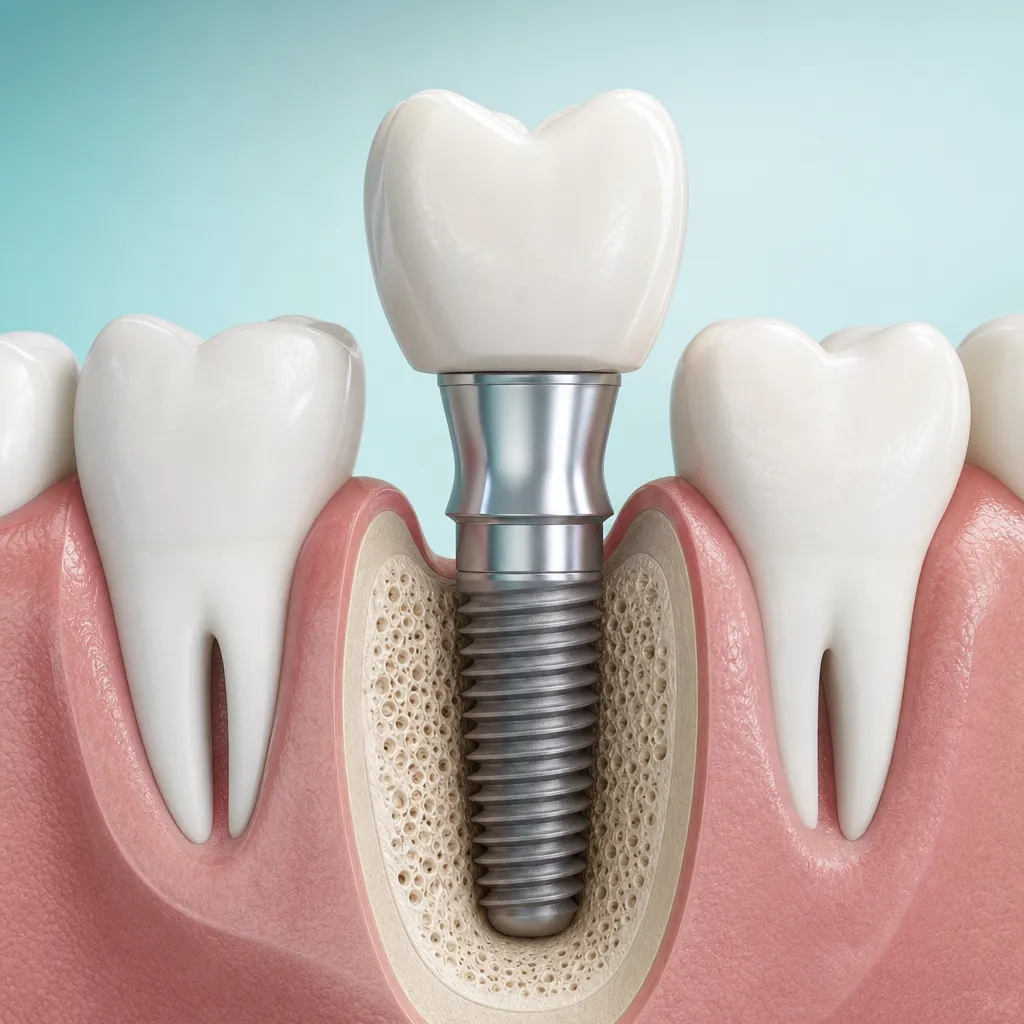
An implant is not one appointment. The titanium post goes into the bone first, and then the bone has to grow onto it, a process that commonly takes three to six months depending on the site and whether it was grafted. The American Dental Association's consumer site, MouthHealthy, describes the same staged sequence: place, heal, then restore.
Only after that healing does the abutment go on and the crown get made and fitted. The second phase is the fussy one. Contacts get adjusted, the bite gets checked, the shade gets matched, and a crown that feels a hair high on Tuesday needs a two-minute fix on Wednesday. Doing that phase 150 miles away means either a second multi-day trip or a stretch of "it feels fine, I'll live with it," which is how people end up with a sore jaw joint or a fractured porcelain edge.
Some clinics offer to place and restore in one visit with a temporary. That is a legitimate protocol in selected cases, but it does not remove the follow-up. It moves it later. Our week-by-week healing timeline gives you a sense of which weeks actually need eyes on the site.
The component problem, and why it matters more than the price
This is the part almost no page on this topic explains, and it is the single most practical thing to understand before you book.
Dental implants are not a standard part. There are hundreds of implant systems on the market, and each manufacturer's fixture has its own internal connection, its own thread, its own screw and its own driver. An abutment made for one system does not thread into another. Widely used systems are stocked here and any reasonably equipped office can service them. Less common or regional brands often are not stocked in the United States at all.
So picture a screw loosening three years after the trip, which is a routine and easily fixed complication. If the fixture is a system your dentist recognizes, it is a short visit: identify the connection, use the matching driver, re-torque, done. If it is an unfamiliar brand and you have no paperwork, that visit turns into detective work. Sometimes a custom-milled abutment solves it. Sometimes an otherwise healthy, well-integrated implant has to come out because there is no way to attach anything to it.
Bring home the following, and do not leave without them:
- The implant card or passport listing manufacturer, product line, diameter, length and lot number for each fixture placed. Photograph it and email it to yourself.
- Your imaging on a USB drive: the pre-op CBCT and the post-op X-rays, as files you can actually open.
- The written treatment record, including any graft material used and where it went.
- The surgeon's full name and license number, not a first name and a clinic logo.
- The warranty in writing, in a language you read, stating what is covered, for how long, and who pays for the return travel.
A clinic that hands over all five without hesitation is telling you something good about itself. One that shrugs is telling you something too.
What happens if it fails after you are home
Any dentist in Downey will treat you for an infection. That is not in question. We can examine you, take an X-ray, drain an abscess, prescribe, and get the pain under control regardless of who placed the implant or where.
What a local office often cannot do is honor someone else's warranty, order parts for a fixture it cannot identify, or re-torque a screw without the matching driver. And if the implant itself has failed, meaning it never integrated or the bone around it has been lost, the repair path is long: remove the fixture, graft the site, wait several months for the bone to mature, then place again. That redo can cost more than everything you saved.
Failure is uncommon. Implants have a strong long-term track record when they are well planned and well maintained. But when it does happen, distance is what turns a manageable problem into an expensive one.
Get seen urgently if… after implant surgery anywhere, at home or abroad, you develop swelling that keeps spreading, fever, pus or a foul taste draining from the site, trouble swallowing or opening your mouth, numbness in your lip or chin that has not faded, or an implant that feels loose or moves. Those need same-day attention, not a wait-and-see week.
What to ask before you book
- Which implant system, exactly? Manufacturer and product line, in writing, before you pay a deposit. "Premium European brand" is not an answer.
- Who places it and who restores it? The same clinician, or two? What are their credentials, and can you verify the surgeon's cédula profesional and specialty registration through Mexico's public registry rather than through the clinic's own website?
- Is a 3D scan included, and do I get a copy? If the plan was built from a panoramic X-ray alone, ask why.
- What exactly is in the quoted price? Fixture only, or fixture plus abutment plus crown? Extraction? Sedation? The advertised number is very often the post by itself.
- What if I need a graft? Get that price now, in writing, not on the morning of surgery when your only leverage is a five-hour drive home.
- What is the warranty? Duration, what voids it, and whether it covers your travel back.
- Who answers the phone at nine at night on day three? Get a real number and test it before you travel.
- Will you send my records to my dentist at home? Ask before treatment, not after.
Those same questions are worth asking on this side of the border. A good office answers all eight without flinching. If you want to see what a complete plan should spell out, hold any quote up against our breakdown of what implant pricing includes and how insurance handles it.
When the math leans local and when it leans across the border
Staying local usually makes more sense when:
- You are replacing one or two teeth. The absolute savings are smallest here, and the travel costs the same as it would for a full arch.
- You have active gum disease, uncontrolled diabetes, a bisphosphonate or similar bone medication, a blood thinner, or a recent history of head and neck radiation. Those cases need staged planning and close follow-up, not a compressed schedule.
- You grind or clench. Bite adjustments matter and they happen over months.
- Unpaid days off cost you real money.
- You want one person accountable from the scan to the final crown.
Going abroad can genuinely pencil out when:
- You are replacing many teeth at once and the absolute gap runs into the thousands.
- You have family to stay with, so lodging is not a line item.
- Your schedule allows two trips without lost income.
- You have arranged, in advance, for a dentist here to handle maintenance and emergencies, and that dentist has already seen your records.
The financing comparison people skip
Most patients weighing a $4,000 local plan against a $1,500 quote abroad are comparing one lump sum to another. That is rarely how the local option gets paid. Spread over eighteen or twenty-four months through CareCredit, Cherry or Sunbit, the monthly number looks a lot less dramatic than the sticker, and no travel is attached to it.
Two other things worth knowing. Dental insurance rarely reimburses care received outside the United States, and plans that will consider it typically require an itemized claim with standard procedure codes that many foreign invoices simply do not carry. Ask your plan before you pay, not after. And for the maintenance side of the equation, our in-house membership plan covers the exams and cleanings that keep an implant healthy, whoever placed it.
Sometimes the real answer is a different treatment
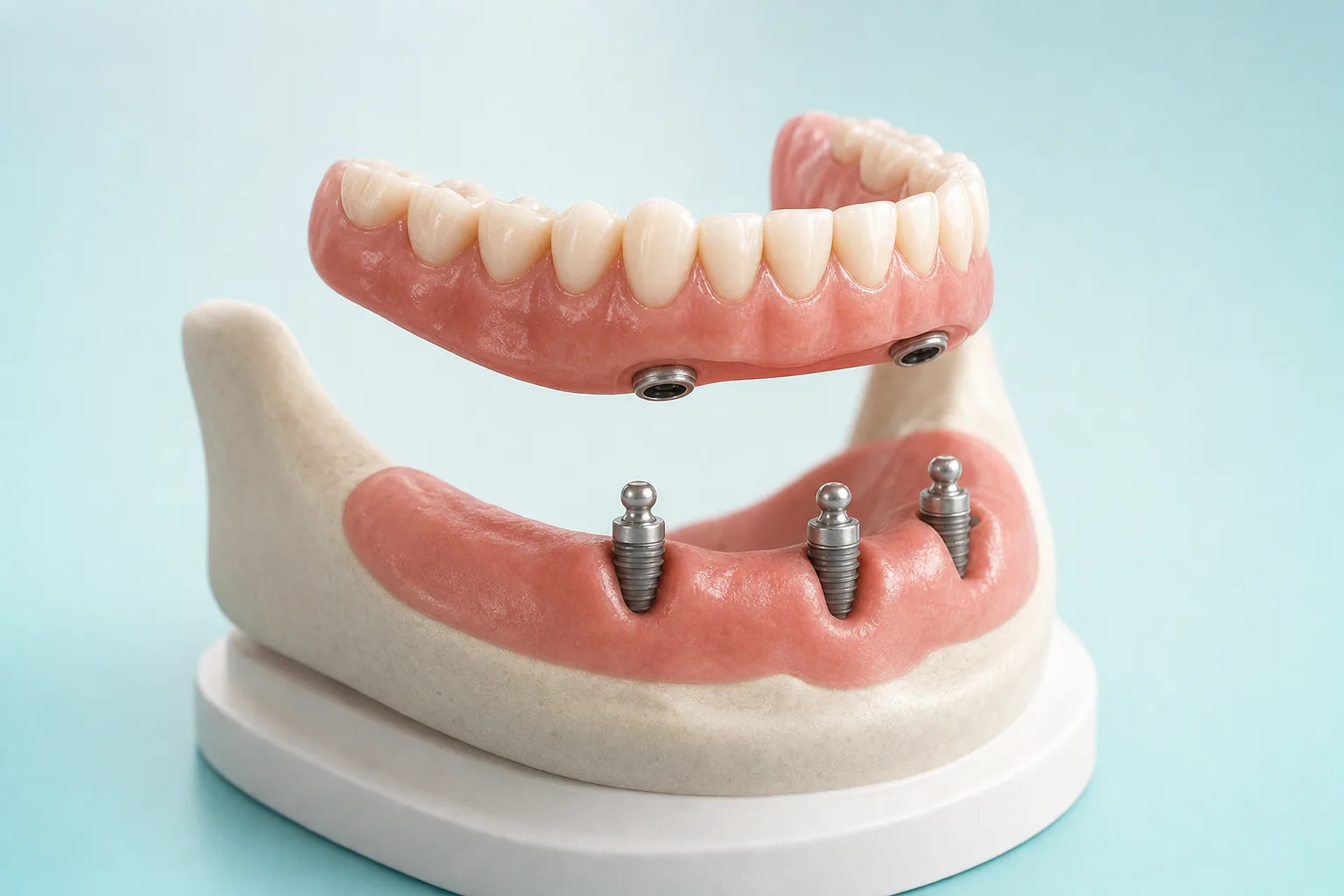
A fair number of people arrive with a cross-border quote and leave having chosen something else entirely. Once the whole picture is on the table, a bridge, a partial, or a removable overdenture retained by four implants can be the better fit for the bone, the budget and the years ahead. Read through the full range of tooth replacement options before committing to any plan, foreign or domestic. For someone missing most or all of a lower arch, a removable overdenture on four implants is often the more predictable and more maintainable choice, and it is what we provide here.
If you already had the work done abroad
You are welcome here, and nobody is going to lecture you. Bring whatever paperwork and imaging you have. A first visit for someone with implants placed elsewhere usually means a baseline X-ray, gentle probing around each fixture to check the tissue and bone level, a bite check, and identifying the system where we can. From there it is ordinary implant maintenance: cleanings with instruments that will not scratch titanium, and periodic imaging so a small change gets caught while it is still small.
Our team is bilingual, and if this is easier to talk through in Spanish, that is how we will do it. We see plenty of patients holding a quote from Tijuana next to one from here, and that conversation happens in Spanish most days.
Before you decide
If you are holding a quote from abroad and want a second opinion on whether the plan actually fits your bone and your bite, bring it in. Call the office at (562) 928-5559 or request a consultation, and you will leave with a written, itemized estimate you can set next to it.
Have questions about your smile?
Dr. Sameer Aljanedi and the team at Rio Hondo Dental Office are here to help. Se habla español.