Implants & Restorative
Implant-Supported Dentures: Your Options, Explained
Implant-supported dentures are a family of options, not one procedure. Two implants or four, upper arch or lower, stud attachments or a bar — the right combination depends on your bone, your bite and your budget. Here is how to tell them apart.
Se habla español · Serving Downey, Pico Rivera, South Gate, Bellflower & nearby
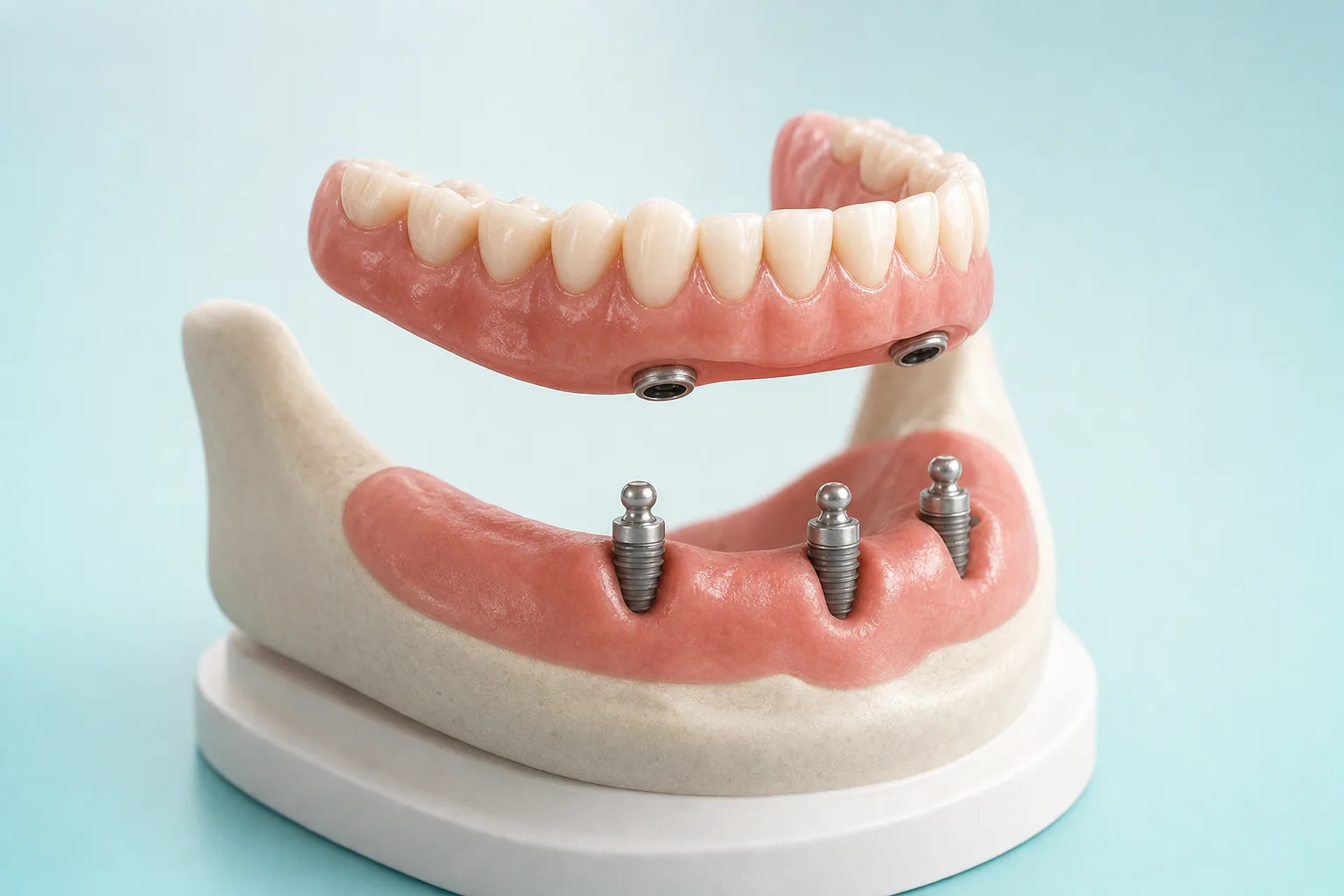
“Implant-supported denture” is a category, not a single procedure. It covers any denture that anchors to implants set in the jaw instead of sitting on gum tissue. Inside that category, three decisions shape the result: how many implants, which arch, and what kind of attachment holds it on.
What is an implant-supported denture?
Short answer: An implant-supported denture is a removable denture that clips onto two or more dental implants placed in the jawbone. The implants hold it still and carry much of the chewing load, and you unclip it at night to clean it. Most patients call them snap-in dentures. The clinical name is an overdenture.
The mechanics are simple. Small titanium posts are placed in bone and left to fuse with it. Each post gets an attachment on top, and matching attachments are fitted inside the denture. Push down and it snaps on. Lift at the right angle and it comes off. In between, it does not rock, slide, or need adhesive.
A permanently fixed full-arch bridge screwed onto implants is a different treatment with a different daily routine. What we provide is the removable version — and a removable overdenture anchored by four implants is the plan most of our full-arch patients end up choosing.
Two, three or four implants: what actually changes
More implants means more stability, more cost, and usually a smaller and more comfortable denture. On a lower arch the whole decision comes down to what the third and fourth implants actually buy you. Here is how the common setups behave.
| Setup | Where it fits | How it feels | Honest trade-off |
|---|---|---|---|
| Two implants, lower arch | The usual entry point, and the biggest single jump in comfort | Stops the lower denture floating and lifting; it can still pivot slightly at the back | The base still presses on gum tissue, so the ridge keeps changing and relines continue |
| Three implants | A compromise dictated by anatomy or budget | Noticeably steadier than two | Rarely a first-choice design; usually a middle step rather than a goal |
| Four implants, either arch | The most requested full-arch plan | Support spread across the arch, rocking largely gone; on an upper, the palate can usually be cut away | Higher upfront cost, and it is still removable with nightly cleaning |
| A bar joining four implants | Heavy bites, uneven bone, higher-demand cases | The most rigid removable option available | Costs more, needs vertical space not every mouth has, and demands meticulous cleaning underneath |
If you already know the four-implant route is what you want, go straight to our detailed page on overdentures secured by four dental implants, which covers the surgery, the healing timeline and long-term attachment maintenance.
Upper and lower dentures are not the same problem
A lower full denture is the hardest prosthesis in dentistry to keep still. It sits on a narrow horseshoe of bone, the tongue lifts it from the inside, the cheeks push it from the outside, and there is no meaningful suction to hold it down. Two implants transform that. The lower arch is where implants pay off fastest and for the least money.
Uppers behave differently. A broad palate creates genuine suction, so a well-made upper denture often holds acceptably — the complaint is usually the plate itself: dulled taste, a triggered gag reflex, food temperature you can no longer feel. Implants let us open up the palate. Because upper bone is softer and the sinuses sit close above it, the upper arch generally wants four implants rather than two, and sinus grafting comes up more often. Bone grafting is a routine step, not a verdict that implants are off the table.
Locator attachments, ball attachments, or a bar?
Stud attachments — locator-style or ball — sit on each implant independently, and a nylon insert inside the denture grips them. They are the common choice: less expensive, quick to service, and the grip can be dialled firmer or looser simply by swapping the insert.
A bar splints the implants together with a milled or cast frame, and the denture clips onto that frame. Load spreads more evenly, rocking is best resisted, and it suits uneven bone or a powerful bite. It also costs more, needs vertical room, and has to be cleaned under carefully every single day.
How this compares with a conventional denture
A conventional full or partial denture remains the right answer for plenty of people, and we make them well — our head-to-head on how a denture that clips onto implants differs from one resting on gum walks through the comparison in detail. The differences that matter:
- Bite force. A conventional denture restores a fraction of natural chewing power. Anchoring to implants restores substantially more — enough that most patients get steak, apples and corn back.
- Adhesive. Snap-in dentures do not need it.
- Bone. The ridge under a conventional denture keeps shrinking, which is why the fit deteriorates and facial support drops over the years. Implants transmit force into bone and slow that loss where they sit.
- Palate coverage. Often removable on an implant-retained upper. Never on a conventional one.
- Cost and time. Higher upfront, and months rather than weeks, because implants have to integrate with bone before they can be loaded.
- Surgery. A conventional denture involves none. This route does.
If you want a neutral second opinion before your consultation, the American Dental Association’s patient site, MouthHealthy, covers denture types in plain language.
Who is a good candidate — and who is not
Most people missing a whole arch, or wearing a denture they have stopped trusting in public, are candidates. Age by itself rules nobody out. Many of the patients who come into our Downey office asking about snap-in dentures have already worn a conventional set for a decade. What genuinely complicates the picture:
- Uncontrolled diabetes. Well-managed diabetes is not a barrier. Poorly controlled blood sugar impairs healing and raises the risk of an implant failing to integrate, so we want it stable first.
- Smoking. Heavy smoking measurably increases failure rates, particularly in the upper jaw. We will still treat you, but you deserve to hear that the odds shift.
- Active gum disease. The bacteria that destroyed bone around your teeth will happily do the same around implants. Clearing the infection first is not optional.
- Certain medications and past radiation. Intravenous bone-modifying drugs and radiation to the jaws call for medical consultation before any surgical plan is made.
- Not enough bone. Common after years in a denture, and usually fixable. The nerve running through the lower jaw and the sinus floor above the upper set hard limits on implant length; a 3-D scan tells us whether grafting opens the door.
- Heavy grinding. Not a disqualifier, but it wears attachment inserts faster and can change the design we recommend.
How we work out how many implants you actually need
- An exam and a 3-D scan. We measure bone height, width and density exactly where implants would go, and map the nerve and sinus.
- An assessment of your current denture, if you wear one. A sound denture can often be retrofitted with attachments rather than remade, which is a real saving.
- A conversation about what you want to eat, whether the upper plate bothers you, and how much daily upkeep you want to take on.
- Budget, discussed plainly. Starting with two implants and adding more later is a legitimate staged plan, and we will tell you when it makes sense.
- A written plan — number of implants, attachment type, sequence, and cost — before anything gets booked.
What drives the cost
Published prices do not survive contact with a real mouth, so we quote in writing after the scan. The factors that move the number: how many implants, whether grafting or a sinus lift is needed, whether your existing denture converts or a new one has to be made, stud attachments versus a bar, and whether you want sedation. Upper arches usually cost more than lower ones because they tend to need more implants and more grafting.
We accept most PPO and HMO plans plus Denti-Cal and Medi-Cal. Coverage for the denture and coverage for implants are often treated as separate questions, and the answer depends on your specific plan and on program rules including frequency limits — so we verify your exact eligibility before treatment rather than guessing at it. See how we handle insurance and Denti-Cal, and ask about CareCredit, Cherry and Sunbit financing if you would rather spread the cost.
Living with them, week by week and year by year
The first two weeks are an adjustment. Speech usually tightens up within days. Snapping the denture in and out feels clumsy at first and takes about a week to become automatic. Gums can be tender where attachments seat, and small adjustments during the first month are expected, not a sign that something went wrong.
Longer term, two things surprise people. The nylon inserts that grip the attachments are consumable parts — they wear, and they get replaced in a short appointment, commonly once or twice a year depending on your bite and how often the denture comes out. And with only two implants, the back of the denture still rests on gum, so the ridge underneath continues to change and periodic relines and repairs stay part of the deal. Anyone promising a maintenance-free implant denture is selling something.
Daily care is simple: out at night, brush the denture and the attachment housings, and clean around the implant posts the way you would around teeth. Implants cannot decay, but the gum and bone around them can become inflamed and recede if plaque is left to sit.
Get seen urgently if… an implant site swells, throbs, tastes foul or leaks pus; an attachment feels loose or the denture suddenly clicks and shifts when it did not before; or numbness in the lip or chin persists after surgery. Caught early, problems around an implant are usually reversible. Ignored, they cost you the implant.
Questions worth asking before you agree to anything
- How many implants are you recommending, and what changes if I have one fewer?
- Stud attachments or a bar — and why that one for my mouth?
- Can my current denture be converted, or do I need a new one?
- Do I need grafting, and how many months does that add?
- What do replacement inserts cost, and how often will I need them?
- Will I be without teeth at any stage? (You should not be.)
- What happens, in writing, if an implant fails to integrate?
Still weighing this against a bridge or individual implants? Our honest comparison of tooth replacement options lays out the trade-offs side by side, and how dental implants work covers the surgical side in more depth.
A scan and a straight conversation will tell you how many implants your jaw can support and what each route would involve. Request a consultation with Dr. Sameer Aljanedi in Downey, or call (562) 928-5559 — se habla español.
FAQ
Frequently asked questions
What is an implant-supported denture?
It is a removable denture that clips onto dental implants in the jaw instead of resting on the gums. Patients call them snap-in dentures; the clinical name is an overdenture. The implants hold it still and carry much of the chewing load, and you take it out at night to clean it.
How many implants do I need?
Two implants will steady a lower denture and are the usual entry point. Four spread the support across the arch and, on an upper, usually let us remove the plate over the palate — which is why uppers generally want four. A 3-D scan of your bone settles the number.
What is the difference between this and an overdenture on four implants?
None in principle — an overdenture on four implants is one specific version of an implant-supported denture, and it is the one most of our full-arch patients choose. Our page on overdentures secured by four implants covers that treatment step by step.
Are they removable or fixed in place?
The dentures we provide are removable. They lock down firmly while you eat and talk, then unclip so you can clean the denture and the attachment points properly. A permanently fixed full-arch bridge is a different treatment with different daily upkeep.
Can my current denture be converted to snap on?
Often, yes. If the denture fits reasonably, has enough thickness and the teeth are not worn out, attachments can frequently be fitted into the existing base rather than making a new one. We assess that at the consultation, because a tired denture is usually better remade than retrofitted.
Will insurance or Denti-Cal cover any of it?
We accept most PPO and HMO plans plus Denti-Cal and Medi-Cal. Coverage for the denture and coverage for the implants are often handled as separate questions, subject to your plan and program rules including frequency limits, so we verify your exact eligibility in writing before treatment. Financing through CareCredit, Cherry and Sunbit is available.