Visit Us
Insurance, Denti-Cal & Payment Options
We accept Denti-Cal and Medi-Cal for adults and children, work with most PPO and HMO plans, and offer financing and an in-house membership plan if you have no coverage at all. You get the cost in writing before anything starts.
Se habla español · Serving Downey, Pico Rivera, South Gate, Bellflower & nearby

Money is the reason most people put off dental care, and it is the reason a lot of them end up in far worse shape than they needed to be. So let us have that conversation first, before anyone sits in a chair.
Do you accept Denti-Cal and Medi-Cal?
Short answer: Yes. Rio Hondo Dental Office in Downey accepts Denti-Cal and Medi-Cal alongside most PPO and HMO plans, and adult patients are genuinely welcome — not limited to exam-only or emergency slots. Bring your card and photo ID and we verify your current eligibility and covered services with the program before anything is scheduled. Se habla español.
Plenty of offices are listed as accepting the program and then make it quietly difficult to actually get in: long waits, restricted appointment types, a front desk that nudges you toward paying privately. That experience is real and it is why some people give up on the dentist entirely. It is not how our Paramount Boulevard office runs, and it is not how program patients get treated here.
What adult Denti-Cal actually covers
California restored comprehensive adult dental benefits years ago and a great many patients never heard about it. The table below is a general map rather than a promise about your case — the Medi-Cal Dental program, run by the California Department of Health Care Services and branded Smile California for members, publishes the current benefit list, and it does change. For the procedure-by-procedure version — the annual dollar limit, the frequency clocks and the molar root canal rule included — see our full guide to the adult Medi-Cal Dental benefit.
| Treatment | Usual adult status | What trips people up |
|---|---|---|
| Exams, X-rays, cleanings | Commonly covered | Covered at set intervals, not on demand. Frequency limits are the single most common reason a visit gets denied. |
| Fillings | Commonly covered | Which material is used can depend on which tooth it is. |
| Extractions and urgent pain relief | Commonly covered | Emergency and pain-relief care is generally handled differently from routine treatment. Never sit on an infection waiting for a coverage answer. |
| Root canals | Covered on many teeth; back teeth are more restricted for adults | If endodontic treatment on a molar is not a benefit in your case, the realistic alternative is extraction plus a replacement plan. |
| Crowns | Often requires prior authorization | What gets approved may be a prefabricated crown rather than a lab-processed one. Ask which you are getting. |
| Full and partial dentures | Commonly covered, usually with prior authorization | Replacements are limited by a multi-year frequency rule, with a documented-exception pathway for genuine cases. |
| Dental implants | Generally not a routine benefit | The denture part of a case may be covered while the implants are self-pay. Ask how the case will be submitted. |
| Whitening, veneers, elective cosmetic work | Not covered | Out of pocket — but financing and current offers apply. |
General guidance, reviewed August 2026. Benefit lists, frequency limits and authorization rules change; we confirm your specific eligibility with the program before treatment is scheduled.
Denture coverage is the line worth underlining. Paid privately, full and partial dentures are expensive, and for someone who has lost most of their teeth that coverage is the difference between eating normally and not. If you later want something that stays put, a removable overdenture that snaps onto four implants is the usual next step — the implant portion is typically self-pay, so ask us to price it separately. That side of a case has its own rules, including a limited state implant benefit now pushed back to 2027: what the program will and will not pay for on implants. Existing plates that have gone loose are a smaller job: see repairs and relines.
Prior authorization: start it before you are in pain
Larger work usually has to be submitted and approved before it can be done. That is not a formality anyone can skip, and it is not instant. The practical consequence is worth planning around. If you know a crown or a denture is coming, come in and let us submit it while the tooth is still quiet. Patients who wait until something hurts end up choosing between an extraction today and an approval that has not landed yet.
Three questions to ask any office before you drive over
- Are you taking new adult Denti-Cal patients right now? "We accept it" and "we are accepting" are two different sentences.
- Can I be scheduled for a cleaning, not only an exam? Some offices quietly limit program patients to exam or emergency appointments.
- Will you submit the authorization paperwork for me? If that answer is vague, you will be the one chasing it.
An office that answers all three plainly is one that actually works with the program. If you are coming to us, what happens at a first visit covers the rest of the practical detail.
Children's benefits are the strongest part of the program
Parents, take this one seriously: children's coverage is comprehensive. Exams, X-rays, cleanings, fluoride varnish, sealants on permanent molars, fillings, extractions and space maintainers when a baby tooth is lost early are all typically included. Sealants and fluoride are the best value in the entire benefit list because they prevent decay rather than repair it — a thin coating over the grooves of the back molars, on exactly the teeth a seven-year-old cannot brush properly.
The American Dental Association recommends a first dental visit by around age one, or when the first tooth appears; its patient site, MouthHealthy, is a reasonable place to read more. That first appointment is mostly familiarity — a ride in the chair, a count of the teeth, a conversation with you about bottles, sippy cups and brushing. Children's dentistry explains how we handle it. One scheduling tip: book the whole family into consecutive slots. Each of you is covered separately, but a single trip means one morning off work instead of three, and children are noticeably calmer once they have watched a parent sit in the same chair.
PPO or HMO? The difference decides what you pay
Patients use "insurance" as one word for two products that behave nothing alike. We work with most plans of either type, and the distinction matters most when treatment gets large.
| PPO | HMO (DHMO) | |
|---|---|---|
| How it pays | A percentage of each service after a deductible; you pay the balance | A fixed copay per procedure from a published schedule |
| Annual maximum | Yes — once you reach it, you pay everything above it | Usually none, but you are limited to what the copay schedule lists |
| Choice of dentist | Any dentist; staying in network costs less | You are assigned to one office; care elsewhere is generally not covered |
| Specialist care | Usually direct access | Usually needs a referral first |
| Waiting periods | Common on major work such as crowns and dentures | Less common |
| Suits you if | You want choice and expect larger treatment | You want predictable, low routine costs |
Two PPO details are worth real money. Most plans reset the annual maximum every January and nothing rolls over, and most cover preventive visits at or near 100%. If treatment has already been diagnosed and is sitting untreated, finishing it before the reset can be the difference of several hundred dollars — our note on using benefits before they expire walks through the timing, and the PPO versus HMO breakdown goes further into the arithmetic.
Four ways a private plan says no
Denials are rarely arbitrary. Almost all of them come down to one of four clauses buried in the policy, and knowing which one you hit decides whether an appeal is worth filing:
- Missing tooth clause. Many plans will not pay to replace a tooth that was already gone before the policy started.
- Waiting period. Major services often sit behind a wait measured in months from enrollment.
- Annual maximum, or a sub-maximum. Some plans set a separate, lower ceiling for implants than the one that applies to everything else.
- Alternate benefit. The plan pays for the least expensive adequate treatment — a bridge or a denture — even when you and your dentist chose an implant. You receive a partial payment, not a denial letter, which is why it surprises people.
The defense against all four is a predetermination: we send the plan the treatment plan before we do it, and they write back what they will pay. It adds some weeks and removes the guessing. Crowns are the usual flashpoint, and how the major plans handle crowns gets specific about it; for bigger cases, implant costs and coverage lays out where plan money usually stops.
Two cards, Medicare, and other common mix-ups
If you have Medi-Cal and a plan through work, bring both cards. Medi-Cal is generally the payer of last resort, so the private plan is billed first and the program is considered for what is left. People often assume two forms of coverage means paying twice; usually it means the opposite.
Medicare gets conflated with Medi-Cal constantly, and they are unrelated. Original Medicare generally does not pay for routine dental care — cleanings, fillings, dentures. Some Medicare Advantage plans include a dental allowance, typically capped each year. If you are on Advantage, bring the card and let us read what the dental benefit actually contains before you plan anything expensive.
No coverage at all? Three routes that work

- Our in-house membership plan. A flat annual fee — currently from $199 for one person — covering exams, cleanings, X-rays and emergency visits, plus a discount on other treatment. It is not insurance: no claims, no annual maximum, no waiting period. That is the point of it.
- Payment plans through CareCredit, Cherry and Sunbit. CareCredit offers short- and long-term plans including 0% interest options on qualifying treatment. Cherry runs contract-free monthly payments with no hard credit check to apply. Sunbit spreads a balance over three to seventy-two months and approves most patients right at the front desk.
- Current new-patient offers. Worth a look before you commit to a treatment plan.
Comparing the three against each other is a fair exercise: membership versus insurance versus financing lays out the math, and what treatment really costs without insurance gives honest ranges.
What waiting actually costs you
Here is the part no coverage page bothers to say. A small cavity is a filling. Left alone it reaches the nerve and becomes a root canal plus a crown. Left longer it becomes an extraction, and then a gap that has to be replaced — which is where tooth replacement and its costs enter the picture. Every rung up that ladder costs more, takes longer and needs more paperwork. Covered cleanings and exams are the highest-value item in any benefit package, and skipping them is precisely how the ladder gets climbed.
Get seen urgently if… you have facial swelling, a fever alongside tooth pain, swelling spreading toward your eye or under your jaw, or any difficulty swallowing or breathing. That is an infection spreading, not a dental inconvenience. Call (562) 928-5559 — or go to an emergency room if breathing or swallowing is affected. We deal with the coverage question afterwards, not first. See emergency dental care for what to do in the meantime.
You see the cost in writing before we start
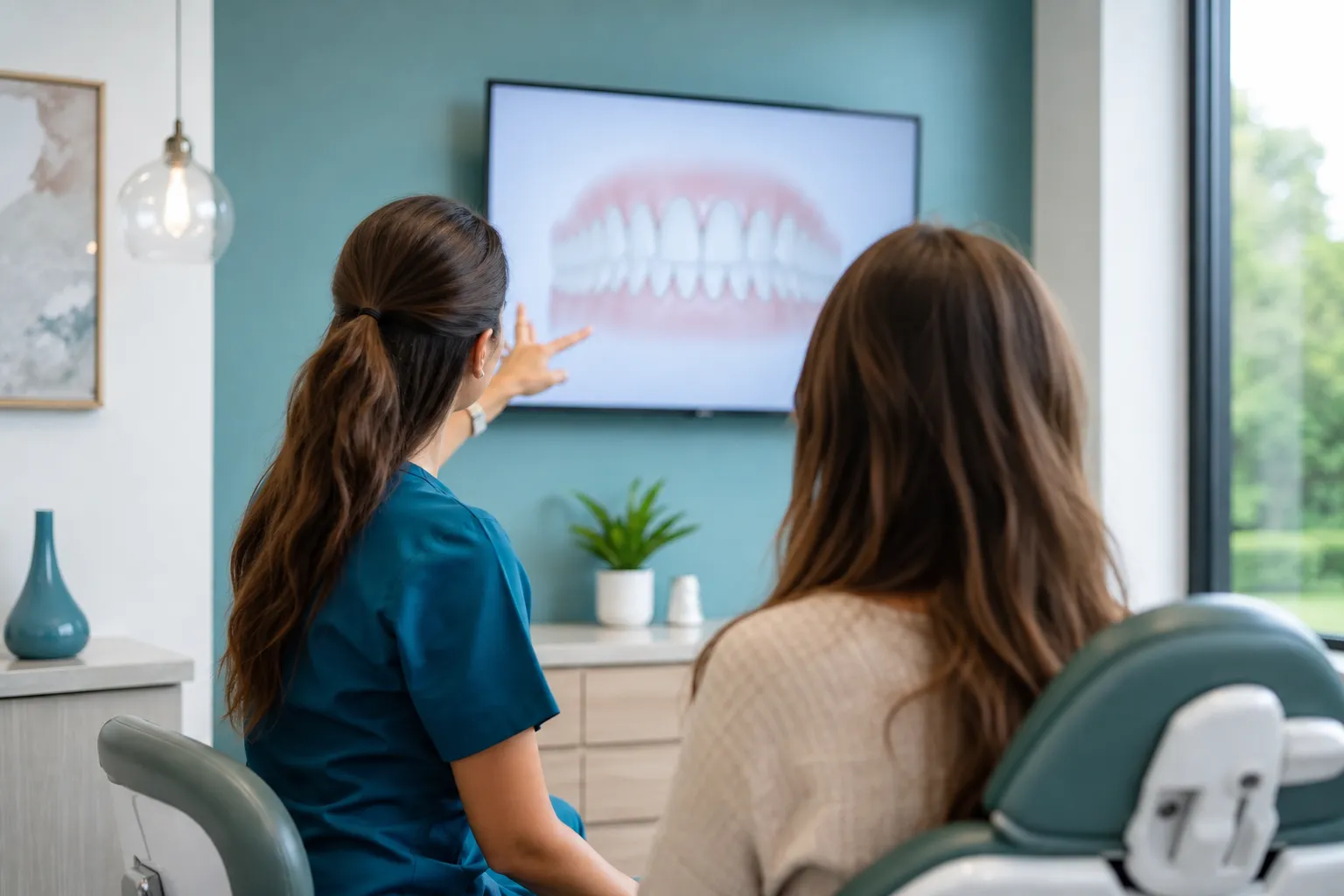
Every treatment plan is itemized, with your estimated plan portion separated from your own portion, before anything begins. Ask for that anywhere you go — a reasonable office hands it over without being asked. If a plan changes mid-treatment, which occasionally happens when an X-ray shows what the surface did not, we stop and talk it through rather than adding a line to the bill.
Bring two things to a first visit: your card and photo ID, and any plan name or member ID you hold. Program eligibility is checked per visit and can shift month to month, so a card in your wallet is not proof you are active today. If you have moved, changed jobs or simply not used it in a while, call with the details and we will run the check before you take time off work. You can also confirm your status through Medi-Cal member services or your county social services office.
Ask before you book, not after
Working out what you are covered for is a phone call, not an appointment. Call (562) 928-5559 or ask us to verify your benefits, and Dr. Sameer Aljanedi's team will tell you what the program or your plan pays — and what it does not — before you commit to anything. Se habla español; there is more for Spanish-speaking families in our bilingual patient guide, and we see families from Downey and the cities around it, including Pico Rivera and Norwalk.
FAQ
Frequently asked questions
Do you accept Denti-Cal and Medi-Cal for adults?
Yes, including new adult patients — not just children and not just emergency slots. Bring your card and a photo ID. Eligibility is verified per visit, so we confirm exactly what you are covered for before any treatment is scheduled. Se habla español.
What does adult Denti-Cal usually cover?
More than most people expect: exams, X-rays, cleanings, fillings, extractions, root canals on many teeth, and full and partial dentures. Crowns and dentures commonly require prior authorization, and frequency limits apply to routine visits. We check your specific benefits with the program before treatment.
Does Denti-Cal cover dental implants?
Implants are generally not a routine benefit. In some cases the denture portion of a case may be covered while the implants themselves are paid privately or financed. We will tell you which parts fall on which side of that line before you commit to anything.
What is the difference between a PPO and an HMO dental plan?
A PPO pays a percentage of each service after a deductible, up to an annual maximum, and lets you choose your dentist. An HMO assigns you to one office and charges a fixed copay per procedure, usually with no annual ceiling. We accept most plans of both types.
Why did my plan pay for a bridge instead of the implant I wanted?
That is an alternate benefit clause. The plan pays for the least expensive adequate treatment and you cover the difference. Asking us to send a predetermination before treatment gets that number in writing in advance instead of after.
I have Medi-Cal and a plan through work. Which one pays?
Bring both cards. Medi-Cal is generally the payer of last resort, so the private plan is billed first and the program is considered for what remains. Having two forms of coverage usually costs you less, not more.
What if I have no insurance at all?
Three routes: our in-house membership plan, a flat annual fee covering preventive care with discounts on other treatment; monthly payment plans through CareCredit, Cherry or Sunbit, including interest-free options for qualifying patients; and our current new-patient offers. Most uninsured patients pay less than they feared.
Will I know what it costs before you start?
Always. You get a written, itemized estimate with your expected plan portion separated from your portion before treatment begins. If something changes mid-treatment we stop and discuss it with you rather than adding it to the bill.