General Dentistry
No Dental Insurance in Downey? Real Costs and How to Pay for Care (2026)
Not having a dental plan is a budgeting problem, not a barrier to treatment. Every dental office in Downey treats uninsured patients, and most of us see them daily.
What actually keeps people out of the chair is the not-knowing. You suspect something is wrong, you have no idea whether the answer is $180 or $1,800, so the call never gets made and the problem gets a year older. This page closes that gap: what common treatments run when nobody else is paying, what makes one person's estimate double another's, and the three realistic ways to cover it.
Can you get dental care without insurance?
Short answer: Yes, and it is routine. Uninsured patients pay through one of three routes — an in-house membership plan, third-party financing spread over months, or cash fees at the time of service. Many people who call themselves uninsured also qualify for Medi-Cal Dental and never check. The one option that reliably costs more than all the others is waiting.
Our office takes most PPO and HMO plans, plus Denti-Cal and Medi-Cal, which a lot of private practices do not. For patients with no coverage at all, we run an in-house dental membership plan that covers routine preventive visits for a flat annual fee. None of that is the point of this article, though. The point is that you should be able to size up your own situation before you pick up the phone.
What dental treatment costs when you pay out of pocket
The ranges below come from published third-party dental cost guides for higher-cost metropolitan areas of California. They are not Rio Hondo Dental's fees, and no honest office can quote a real number before an exam. Use them as a frame of reference — enough to know whether you are looking at a two-figure problem or a four-figure one.
| Treatment | Commonly published range | What moves it inside that range |
|---|---|---|
| Comprehensive exam with X-rays | $75 – $250 | How many images; whether a 3D scan is needed |
| Routine cleaning, healthy gums | $90 – $200 | Time required; how long since your last visit |
| Deep cleaning, per quadrant | $200 – $450 | Pocket depth, bone loss, how many quadrants are involved |
| Composite filling | $150 – $450 | Number of tooth surfaces; front tooth versus molar |
| Crown | $900 – $2,500 | Material and lab; whether a buildup or post is needed first |
| Root canal | $700 – $1,800 | Front tooth versus molar; canal count; retreatment |
| Simple extraction | $150 – $350 | Tooth position; how intact the roots are |
| Surgical extraction | $250 – $650+ | Bone removal, sectioning the tooth, sedation |
| Single implant with abutment and crown | $3,000 – $6,000 | Grafting, sinus work, sedation, restoration type |
| Full denture, per arch | $1,200 – $3,500 | Tooth grade, base material, immediate versus definitive |
Two things stand out if you read the right-hand column. Most of that spread is clinical rather than commercial — one procedure code can cover wildly different amounts of work. And nearly everything expensive on that list began as something cheap on that list.
What actually drives the number on your estimate
Exams and X-rays
An exam is priced by what gets captured, not by how long the dentist talks. A limited exam for one painful tooth with a single film sits at the bottom of the range. A full-mouth series or a panoramic image, plus periodontal charting around every tooth, sits at the top. If you are being evaluated for implants or wisdom teeth, a 3D cone-beam scan is usually its own line item.
Ask whether the exam fee includes images or whether those are billed separately. Offices genuinely differ on this, and that one question explains most of the "why is this more than I was told" moments at the front desk. Our new patient page lays out what a first visit here covers.
Cleanings, and the one that costs four times more
This is the most common shock in dentistry. You book a cleaning, you get told you need a deep cleaning, and the number quadruples. It is not a bait and switch — they are different procedures. A routine cleaning removes deposits above the gumline on gums that are healthy. Scaling and root planing cleans root surfaces below the gumline where bone has already been lost, usually with anesthetic, usually across two appointments, and it is priced per quadrant. So the total depends on whether one corner of your mouth is involved or all four.
Which one you need is measurable, not a judgment call: pocket depths charted around each tooth, bleeding on probing, and bone levels visible on X-rays. Ask to see your numbers. Any office should be willing to show you the chart and explain what changed since last time.
Fillings
A composite filling is priced by how many surfaces of the tooth are involved. One small spot on a front tooth is a fraction of a three-surface restoration wrapping around a back molar. The catch is that decay does not stay one surface. Left alone it spreads, and the tooth that needed a filling in March can need a crown or a root canal by the following spring.
Crowns
Material accounts for less of the price than most patients assume. What pushes a crown estimate up is what sits underneath it: a tooth broken down far enough to need a core buildup, a post inside a root-canal-treated root, or crown lengthening if the fracture runs below the gum. A crown quote that does not spell out those contingencies is a partial quote.
Root canals
Price tracks anatomy. A front tooth has one canal. A molar commonly has three or four, occasionally more, and takes considerably longer to treat. Retreating a tooth that had a root canal years ago costs more again, because the old filling material has to come out before anything else happens. And a root canal is rarely the whole bill — a back tooth almost always needs a crown afterward to keep it from splitting, and that second number belongs on your estimate from day one, not as a surprise six weeks later.
Extractions, and what replacing the tooth costs
A loose, intact tooth that lifts out with forceps is a simple extraction. A tooth broken at the gumline, curved-rooted, or impacted becomes surgical, and the fee reflects bone removal, sectioning the tooth and sutures. Taking a tooth out is often the cheapest way out of pain this week and the most expensive choice over ten years, because the gap does not stay a gap. Neighboring teeth drift into it, the opposing tooth over-erupts, and the ridge of bone underneath shrinks — fastest in the first year, according to public health sources including the NIDCR.
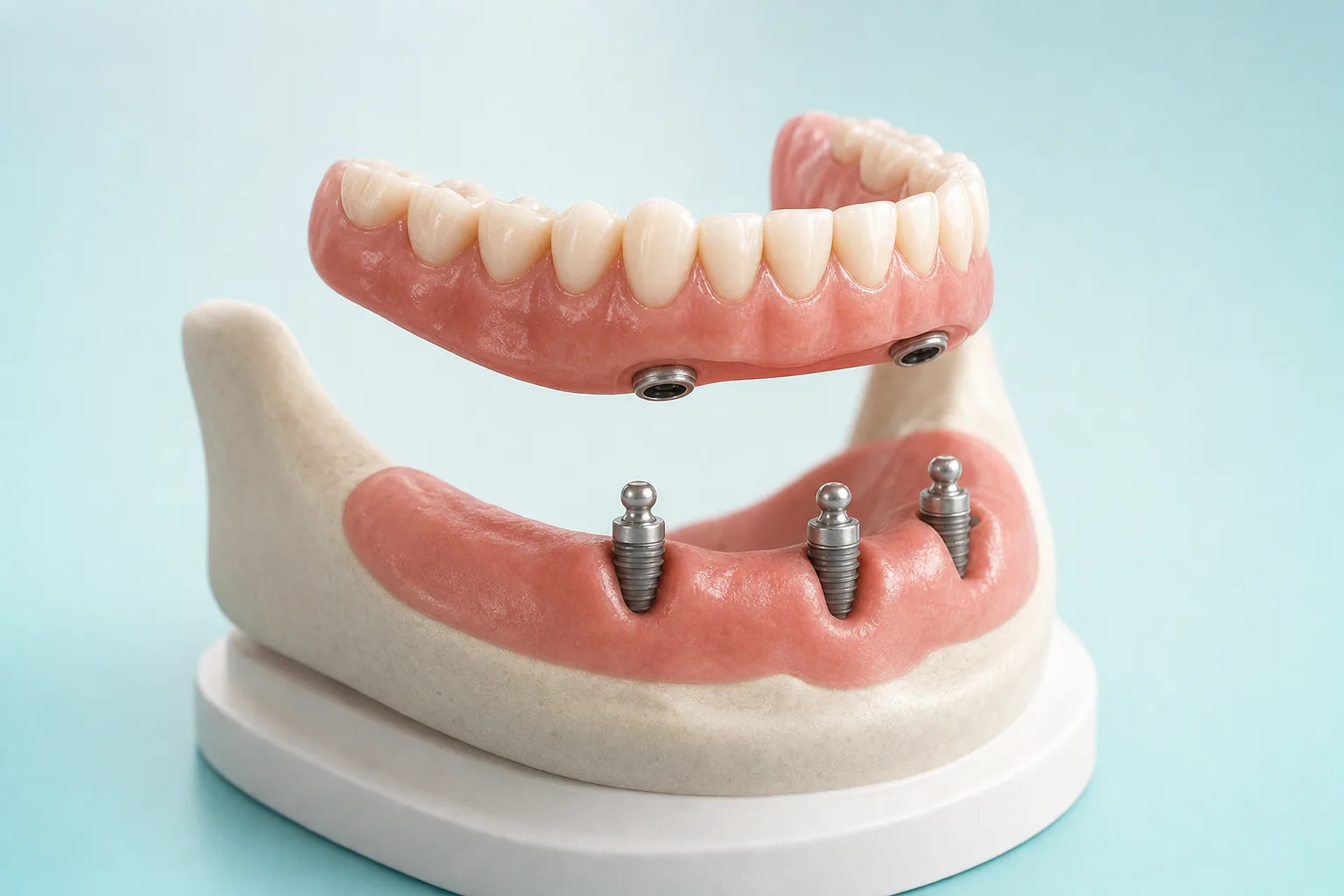
Replacement is where the real money sits, and the honest ladder runs from a partial denture at the low end, through a bridge, up to a single dental implant. Our overview of the ways to replace a missing tooth compares them without the sales pitch. For a full arch we place removable overdentures retained by four implants rather than a fixed appliance, which changes both the cost and the daily routine.
Membership plan, cash, or financing: how the math works
Three ways to pay, and they are not really competitors. Most patients without coverage end up using two of them at once.
| Option | Works best when | What it will not do |
|---|---|---|
| In-house membership plan | You have no coverage and need preventive care plus occasional treatment | It is not insurance — no annual maximum protecting you, no benefits at another office |
| Cash at time of service | You need one procedure and want it done without paperwork or waiting | Nothing spreads the cost; a large plan lands all at once |
| Third-party financing | Treatment is urgent or large and has to be split across months | It does not reduce the fee, and promotional interest terms can bite |
| Buying an individual dental policy | You know major work is coming and can wait out the waiting period | Annual maximums, waiting periods and missing-tooth clauses often cancel the benefit |
Running the membership numbers
Our plan starts at $199 a year for one person, $299 for two and $399 for a family. It covers comprehensive and annual exams, two routine cleanings, necessary bitewing X-rays, oral cancer screening and unlimited emergency exams, plus a member discount on other treatment. Call for the current benefit schedule rather than assuming — that is the part worth confirming out loud.
Now set it against the cash column above. Two cleanings plus an exam with X-rays, paid separately at commonly published area rates, land somewhere around $255 to $650 for one adult in a year. The preventive care alone tends to cover the fee before you touch the discount on anything else. A fuller breakdown lives in our piece on how the membership plan works out for families with no coverage.
Where it does not help you: there is no annual maximum shielding you from a catastrophic year, and it only works at our office. If you move away, it does not travel with you.
When buying your own dental policy is actually worth it
Individual dental policies get sold hard, and for some people they are the right call. Read the mechanics first. Most cap benefits somewhere around $1,000 to $2,000 a year, apply waiting periods of six to twelve months before covering major work like crowns and root canals, and exclude teeth that were already missing the day the policy started. Premiums that look small monthly turn into real money annually.
The arithmetic is not complicated. If premiums plus deductible plus your share of the fees exceed what the plan will actually pay out this year, you are buying paperwork. If you need a crown and a root canal and you can wait out the waiting period, a policy usually wins. Our comparison of how HMO and PPO dental coverage behave differently goes deeper, and what plans typically pay toward a crown is a useful reality check before you sign anything.
Financing, and the fine print people skip
We work with CareCredit, Cherry and Sunbit. They approve differently — some run a soft credit check, some are built for thin credit files, and approved amounts vary a lot between applicants. What matters more than approval is the shape of the promotional period.
Many healthcare credit promotions are deferred-interest offers rather than true zero-percent loans. If the balance is not paid in full by the end of the promotional window, interest can be charged retroactively on the original amount rather than on what is left. That is legal, it is disclosed, and it is routinely missed. Before signing, divide the total by the number of promotional months and ask honestly whether that payment survives a bad month. If it would not, take a longer term at a stated interest rate instead — it usually costs less than a retroactive interest charge.
If you want the mechanics of all three routes side by side, our guide to membership versus insurance versus financing covers the same ground from the payment angle.
Check whether you qualify for Denti-Cal before assuming you do not
A meaningful share of people who describe themselves as uninsured are eligible for Medi-Cal Dental and have never applied — or were covered as a child and assume adult benefits do not exist. They do. Adult benefits have commonly included exams, cleanings, fillings, extractions and dentures, subject to program rules, frequency limits and prior authorization for certain services.
Program specifics change, so we do not guess at them. We verify your exact eligibility and benefits before any treatment is planned, and we tell you in plain terms what the program is likely to cover and what it is not. We accept Denti-Cal and Medi-Cal, which is worth stating plainly because many private offices around Downey do not. Start with our Denti-Cal and Medi-Cal page, and for more detail on the adult side read what adult Denti-Cal benefits actually cover. Nuestro equipo habla español — our Spanish-language guide for local families covers this in Spanish.
What waiting actually costs
Delay is a legitimate financial decision and plenty of people have to make it. Just be clear about the trade, because dental problems do not hold still while you save.
The progression is dull and predictable. A small cavity becomes a large one. A large one reaches the nerve. A nerve infection needs a root canal and a crown instead of a filling. An untreated infection eventually costs the tooth, and then you are pricing replacement instead of repair. That path turns a couple-hundred-dollar problem into a several-thousand-dollar one over a few years, and the expensive version starts with losing something you cannot get back. The CDC has reported that roughly one in four working-age adults has untreated tooth decay, so this is the ordinary path rather than the unlucky one. Our post on what skipping cleanings really costs follows the same arithmetic on the gum side.
Get seen urgently if… you have facial or jaw swelling, a fever alongside tooth pain, pain that wakes you at night or does not respond to over-the-counter medication, a knocked-out adult tooth, or bleeding that will not stop. Swelling spreading toward the eye or under the jaw, or any trouble swallowing or breathing, is an emergency room visit now — not a dental appointment tomorrow. Money is never a reason to sit on a spreading infection. Call, say exactly what is happening, and we sort out payment after you are safe. Our emergency dental page covers what to do while you are on your way.
Questions worth asking before you agree to treatment
- Can I have this in writing, itemized? A total is not an estimate. Line items are.
- What is urgent, what can wait, and what is elective? A good treatment plan sorts into those three buckets on request.
- What happens if I only do the urgent part this year? You are allowed to phase treatment. Ask what the phased version actually risks.
- Does the crown fee include the buildup, and does the root canal fee include the crown? These are the two most common gaps between a quote and a final bill.
- Is there a less expensive option that is still reasonable? There often is. There is also often a reason it was not offered first — listen to the reason before deciding.
- What does this cost if I pay for the whole thing today? Ask directly. The worst answer is no.
An office that answers all six without flinching is quoting from a diagnosis. One that will not is quoting from a price list.
Common questions from patients without coverage
Will a dentist refuse to see me if I have no insurance?
No. Coverage status has nothing to do with whether you can be examined and treated. What changes is how the visit gets paid for, and that is a front-desk conversation rather than a clinical one.
Is treatment more expensive without insurance?
Not automatically. Uninsured patients pay the office fee directly instead of a negotiated network rate, but they also skip premiums, deductibles, annual maximums, waiting periods and denials. Whether your year costs more depends almost entirely on how much treatment you need.
Should I wait until I have insurance before being seen?
Get examined now either way. An exam tells you whether waiting is safe, and it commonly costs less than a single month of premiums. If it turns out everything can wait six months, that is worth knowing. If it turns out it cannot, that is worth knowing more.
Can I pay for only part of my treatment plan?
Almost always. Treatment can be sequenced by urgency across months, or across two benefit years if you do have partial coverage. Say your budget out loud at the consultation — it changes what gets recommended and in what order.
Do you run any discounts or promotions?
Current offers are listed on our specials page and they change through the year. Ask what applies to your plan when you book, and ask again if treatment gets scheduled months out.
Start with an exam, not a guess
You cannot budget for a problem nobody has looked at yet. Come in, get examined, and leave with a written plan sorted by urgency plus a straight conversation about which payment route fits your situation. Request an appointment or call (562) 928-5559 — our Downey team is bilingual and se habla español.
Have questions about your smile?
Dr. Sameer Aljanedi and the team at Rio Hondo Dental Office are here to help. Se habla español.