Specialty Care
Night Guards & TMJ
Waking with a sore jaw, morning headaches, or teeth that look shorter than they used to? You are probably grinding in your sleep. A custom guard will not stop the habit — it takes the force off your teeth and lets the muscles rest.
Se habla español · Serving Downey, Pico Rivera, South Gate, Bellflower & nearby
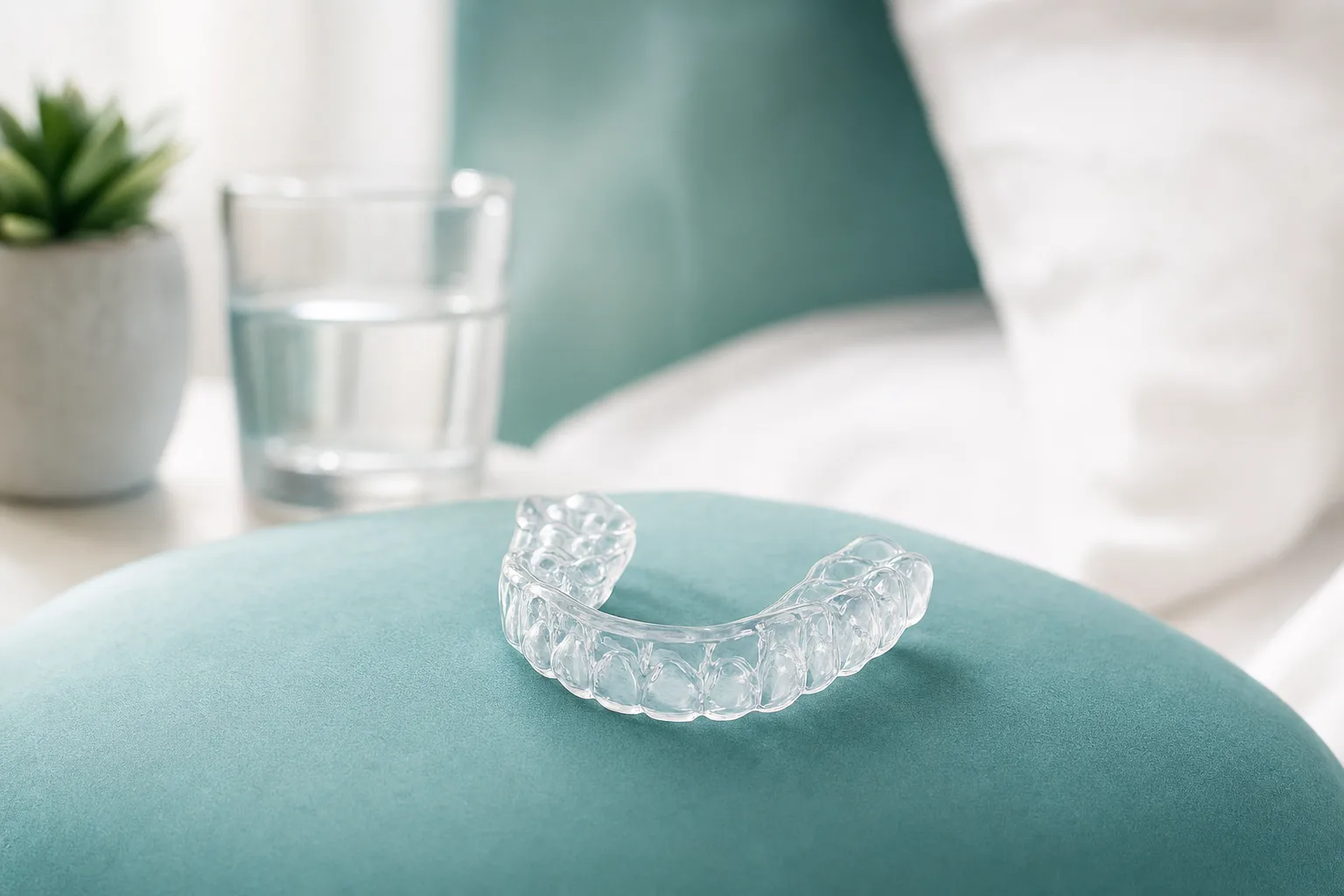
Most people who grind their teeth have no idea they do it. The evidence turns up sideways — a dull ache along the jaw before you have even had coffee, front teeth that look shorter in photos than they used to, a filling that chips for the third time. It happens while you are asleep, when nothing stops you biting as hard as your muscles can manage.
Will a night guard actually stop the grinding?
Short answer: No, and no honest guard claims to. A night guard does not switch off the muscle habit. It puts a precisely fitted layer between your arches so the force lands on acrylic instead of enamel, and spreads that load evenly rather than through two or three unlucky teeth. Sore, tight jaw muscles usually ease within a few weeks too.
Clenching is driven by something upstream — stress, fragmented sleep, certain medications, alcohol or a late coffee. The guard buys your teeth time while the rest gets sorted out. Our longer piece on how stress shows up in your teeth goes into that side of it.
Signs you are clenching or grinding at night
- Jaw muscles that feel tired or tight on waking, easing as the day goes on
- Headaches that start at the temples, first thing in the morning
- Front teeth with flat, polished edges; back teeth with cupped-out chewing surfaces
- Teeth that ache to cold early but settle by mid-morning — the pattern we cover in morning tooth sensitivity
- Fillings, crowns or veneer edges that keep breaking
- A ridged white line along the inside of your cheek, or scalloped edges on the sides of your tongue
- A partner who hears it
Two or more of those together is worth an exam. Grinding wear is easy to confirm: slide the jaw sideways and the flattened areas on upper and lower teeth line up like puzzle pieces. Chewing food does not do that.
Custom guard, mail-order kit, or the one from the drugstore
All three cover teeth. They are not the same product, and the difference shows up in whether you are still wearing it in six months.
| Custom, made in-office | Mail-order impression kit | Drugstore boil-and-bite | |
|---|---|---|---|
| How it is made | Digital scan or impression taken by us, plus a bite record; lab-processed | You take your own impression at home and post it off | You soften a stock tray in hot water and bite into it |
| Fit and bite | Seated and adjusted in your mouth until contacts are even | As good as the impression you managed to take; no adjustment | Approximate, and it loosens as it warms |
| Material | Hard, soft or dual-laminate, chosen for your case | Usually one stock material and thickness | Soft, springy EVA |
| Who looks at your teeth first | A dentist checks for cracks, decay, gum and joint problems | Nobody | Nobody |
| Typical service life | Commonly several years with care | Shorter, and remakes are on you | Months, often less |
| Main drawback | Highest cost; needs two visits | Problems in your mouth go undiagnosed | Bulky, poor retention, can increase clenching |
Why a soft drugstore guard can backfire
Soft EVA is springy, and for some people a springy layer is simply something to chew on. Muscle activity goes up instead of down and they wake more sore than before. Coverage is the second problem: a guard that reaches only a few teeth leaves the rest free to drift, and over months an uncovered molar can move enough to change how your teeth meet. The third is blunter — a loose guard lying on the pillow at 2am protects nothing.
If a store guard is genuinely what this month allows, choose one that covers the whole arch and replace it the moment it is chewed through. Then ask us about payment options. A guard usually costs less than the first crown it prevents.
Hard, soft, upper or lower
- Hard processed acrylic — the workhorse for heavy grinders and anyone with real wear. It does not invite chewing, it adjusts precisely, and it absorbs years of abuse.
- Dual-laminate — soft lining inside, hard shell outside. Kinder on tender teeth and easier to seat over crowded ones.
- Soft — reasonable for light clenchers or short-term cover after treatment. It wears through fastest and is the type most likely to encourage chewing.
- Upper versus lower — upper is the usual choice, but a lower guard is often easier to tolerate if you gag, and can sit better around certain bites and existing crowns.
- Front-teeth-only devices — these have a legitimate short-term use, but worn for months without review they can let the back teeth drift and alter your bite. Nobody should be wearing one indefinitely without check-ups.
What getting one actually involves
- Exam and records. Wear patterns, cracks, muscle tenderness, joint sounds, X-rays — and photographs of the wear, which matter later if a claim is borderline.
- Treat what is active first. Decay or a failing filling gets handled before the guard is made; otherwise the shape underneath changes and the fit goes with it.
- Scan or impression. One short appointment with a bite record, and we settle on arch, material and thickness together.
- Lab fabrication. Commonly around one to two weeks.
- Delivery and adjustment. We seat it, check that contacts are even the whole way round, and adjust until nothing hits first. A guard that rocks or feels high has not been finished.
Expect the first few nights to be odd — more saliva than usual, and a fair chance you find the guard on the pillow. Most people settle inside two or three weeks. If one tooth feels high or a single spot takes all the pressure, call us. That is a five-minute adjustment, not something to put up with.
What drives the cost, and what insurance usually does
No figure here, because it genuinely varies — but you should know what moves it: which arch, whether the guard is hard, soft or dual-laminate, how thick it needs to be for the force you generate, whether a lab fabricates it, and whether worn or cracked teeth need repair before it is fitted. Remakes and lost guards are the cost nobody budgets for.
Many dental plans do list an occlusal guard as a covered benefit, typically with a frequency limit measured in years rather than months. Some cover it for grinding but exclude jaw-joint diagnoses, which is why documentation decides borderline claims: symptoms recorded in the chart, photographs of the wear, and a clear diagnosis. We assemble that as a matter of course. Coverage under Denti-Cal and Medi-Cal varies and is subject to program rules and frequency limits, so we verify your exact eligibility before anything is made rather than guessing at it.
When a night guard is the wrong tool
- Loud snoring, witnessed pauses in breathing, waking unrefreshed. A plain guard does not treat sleep apnea and in some people makes night-time breathing harder. We screen first — an appliance for snoring and sleep apnea is a different device with a different job.
- A joint that locks, catches, or will not open fully. That is a joint problem rather than a muscle one, and it needs assessing before anything is made.
- Teeth already loose from gum disease. Stabilise the gums first, or the guard loads teeth that cannot take it.
- Pain that is not behaving like dental pain — constant, burning, strictly one-sided, or spreading through the ear and neck. Worth investigating properly rather than covering with acrylic.
For jaw-joint pain in general, the NIDCR advises starting with conservative, reversible measures — soft foods, moist heat, resting the jaw, laying off gum and nail-biting — before anything that permanently alters teeth or the joint. That is how we approach it too.
Get seen urgently if… your jaw locks open, or will not open more than about two fingers' width; your teeth suddenly stop meeting the way they used to; or you have facial swelling with a fever. Jaw pain arriving alongside chest pressure, sweating or breathlessness is a 911 call rather than a dental one — jaw pain can be a heart symptom.
Cracked a tooth overnight or woken up in real pain? Start with emergency dental care.
What to ask before you agree to one
- Which arch are you making it for, and why that one?
- Hard, soft or dual-laminate — and what is that choice based on in my case?
- Will you adjust the bite on it at delivery, and check it again a few weeks later?
- What happens if it does not fit, or I chew through it in six months?
- Have you photographed and charted the wear, so my insurer can see the evidence?
Any dentist should be able to answer those without hesitating.
Making it last
Rinse it in cool water when you take it out, brush it gently with a soft brush and no toothpaste — toothpaste is abrasive and dulls the surface — then let it dry in a vented case. Hot water, the dishwasher and a parked car all warp it permanently. Dogs love them, so keep it up high.
Bring it to every cleaning visit so we can check the fit and how it is wearing. Chewing through a hard guard within a year is information rather than a failure: it points to heavy forces, and usually means the teeth deserve a look too — a crown on a cracked molar, or the crown, onlay or veneer decision for worn front teeth. Daytime clenching is a separate conversation, and so is a sports mouthguard — that one is built for impact and is not interchangeable with this.
If you are waking with a sore jaw, or someone has pointed out wear you did not know about, book an exam and we will tell you plainly whether a guard is the right tool for what is actually going on. Request an appointment with Dr. Sameer Aljanedi in Downey, or call our team — we accept most PPO & HMO plans plus Denti-Cal and Medi-Cal, and se habla español.
FAQ
Frequently asked questions
How do I know if I grind my teeth?
Morning jaw tightness that eases through the day, headaches at the temples on waking, flattened or cupped-out chewing surfaces, restorations that keep breaking, and a ridged white line inside your cheek. We can usually confirm it in minutes — grinding wear on upper and lower teeth matches up when you slide your jaw sideways.
Is a custom night guard worth it over a drugstore one?
For most people, yes. A store guard is a stock tray softened over your teeth: bulky, loose once it warms, and for some patients the springy material invites more chewing rather than less. A custom guard is fitted, adjusted in your mouth so nothing hits first, and comfortable enough that you keep wearing it.
Can a night guard help my TMJ jaw pain?
Often it helps, by reducing the load on tired muscles overnight. It is not a cure for the joint itself, and if your jaw locks, catches or will not open fully, that needs assessment before any appliance. Conservative, reversible steps come first — soft foods, moist heat, resting the jaw.
Does insurance cover a night guard?
Many dental plans list an occlusal guard as a covered benefit, usually with a frequency limit measured in years. Some plans cover it for grinding but exclude jaw-joint diagnoses, so documented symptoms and photographs of the wear matter. Denti-Cal and Medi-Cal coverage varies with program rules, and we verify your exact eligibility before anything is made.
How long does a night guard last?
A hard processed guard commonly gives several years; soft guards wear through much faster. Heavy grinders go through them quicker, and that is worth knowing — chewing through one inside a year tells us the forces involved and usually means we should look at the teeth themselves too.
Can I wear one if I snore or have sleep apnea?
Tell us first. A plain night guard does not treat sleep apnea, and in some people it can make night-time breathing harder rather than easier. If you snore heavily, have been told you stop breathing, or wake unrefreshed, we screen for that before making anything — a snoring appliance is a different device.