Implants & Restorative
Overdentures Supported by Four Dental Implants
A denture that moves when you chew isn't a fit problem you can fix with more adhesive. An overdenture anchored to four dental implants snaps into place, holds while you eat and talk, and still lifts out at night for cleaning.
Se habla español · Serving Downey, Pico Rivera, South Gate, Bellflower & nearby
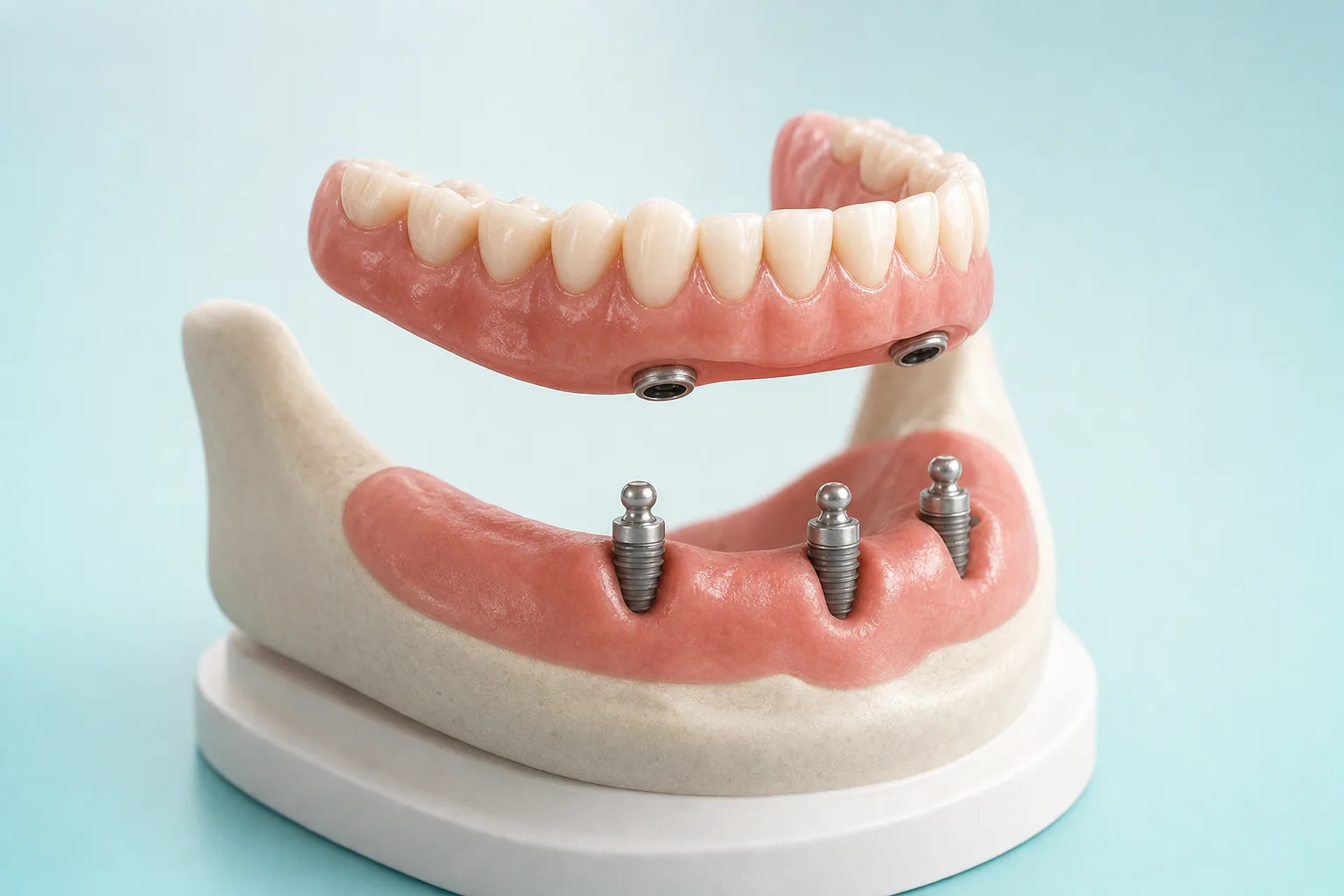
What an overdenture on four implants actually is
Short answer: An overdenture is a full denture that snaps onto implants instead of resting on your gums. Four implants spread the load across the arch, so the denture stops rocking and stays put while you chew. You still lift it out at night to clean it and the attachment posts — the grip comes from the implants, not from suction or adhesive.
Four dental implants are placed in the jaw and left to fuse with the bone. Small attachments screw onto them, and matching housings inside the denture click down over those attachments. Think of the snaps on a jacket: firm enough that biting into a sandwich won't lift the denture, easy enough that your fingers pop it out in a second.
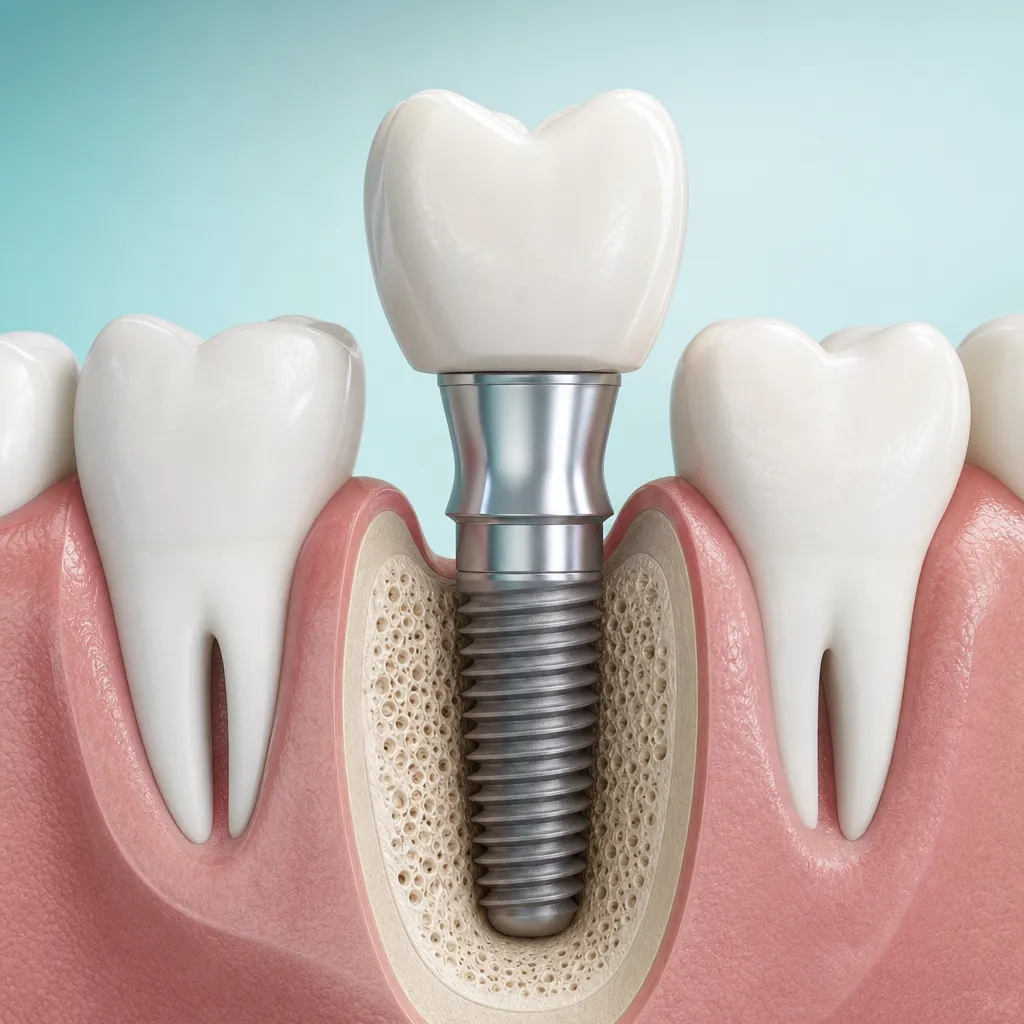
One piece of vocabulary worth clearing up, because the internet muddles it. Implant-supported dentures is the umbrella term for any denture that gets its hold from implants — two of them, four, or a milled bar. This page covers the specific version we place most often: a removable overdenture retained by four implants. If you're still comparing formats, start with the broader category page, then come back here for the detail.
Removable is a first-choice treatment, not a consolation prize
Patients ask some version of this at nearly every consultation: is the removable one the budget version, and the fixed one the real thing? No. Removable implant overdentures earned their standing on evidence, not on price.
Two international consensus statements — one from researchers meeting at McGill University in 2002, a second at York in 2009 — reached the same conclusion: for a lower jaw with no teeth, a denture retained by implants should be considered the first-choice standard of care, and the conventional lower denture should no longer be the automatic default. Those statements were built around two implants. Four extend the same principle with wider support and less movement.
The reasoning is unglamorous. A conventional lower denture sits on a ridge of bone that keeps shrinking once the teeth are gone, so a fit that was excellent in year one is loose by year five and miserable by year ten. Implants interrupt that in the bone around them and give the denture something solid to hold. That single change — resting on tissue versus anchoring into bone — is the whole story, and we lay it out in a side-by-side look at snap-in and conventional dentures. The ADA's patient library, MouthHealthy, lists implant-retained overdentures among the standard ways to replace a full arch — mainstream dentistry, not a workaround.
Conventional denture vs. two implants vs. four
| Conventional denture | Snap-in on 2 implants | Overdenture on 4 implants | |
|---|---|---|---|
| What holds it in | Suction, ridge shape, adhesive | Two attachments at the front of the jaw | Four attachments spread across the arch |
| Movement while chewing | Noticeable — slides and tips | Front anchored, back can still lift | Minimal in most cases |
| Roof of the mouth (upper arch) | Fully covered by acrylic | Usually still covered | Often can be opened up |
| Bite strength | Lowest — soft foods dominate | Clear improvement | Closest to a natural bite of the three |
| Effect on the jawbone | Ridge keeps resorbing | Preserved around the implants | Preserved across a wider span |
| Surgery involved | None | Two implants | Four implants |
| Relative cost | Lowest | Middle | Above a snap-in, well below replacing every tooth |
| Taken out to clean | Yes | Yes | Yes |
Two implants is a legitimate treatment, and for some budgets it's the right one — a conventional denture upgraded that way is a real jump in stability. Its weakness is geometry. With both anchors at the front, the denture pivots around them like a seesaw and the back edge still lifts when you bite down on something firm. Four attachments, positioned wider, take that rotation away. On an upper denture the case for four is stronger again: upper bone is softer, and the main reason to add implants up there is to cut away the acrylic plate over your palate, which is where your sense of taste and food temperature lives.
In many cases implants can be added later to an existing two-implant overdenture, so starting smaller isn't a dead end — and what the third and fourth implants actually buy you is worth reading before you settle on a number. Raise it before the denture is made, though — the design is far easier to plan for from the beginning.
The attachments: the part nobody explains until it's in your mouth
This is the component patients are rarely told about, and it decides how the whole thing feels a year in.
The common design uses stud-style attachments. A small abutment screws into each implant and sits just above the gum; a nylon insert inside the denture snaps over it. Those inserts come in different retention strengths, so we can start you softer while you learn the in-and-out motion, then go firmer once your hands know the movement.
Nylon wears out. That isn't a flaw — it's the point. The insert is designed to be the sacrificial part instead of the implant. Expect inserts to be swapped periodically, commonly once or twice a year depending on how hard you snap it in and whether you grind. Replacement takes minutes in the chair. Budget for it the way you'd budget for tires.
The other design splints the implants together with a custom bar, and the denture clips over the bar. It spreads force more evenly and holds harder, costs more up front, and demands more careful cleaning underneath. Which suits you depends on your bone, your bite, and how well your hands work.
Step by step, consultation to finished denture
- Consultation and 3-D scan. A cone-beam scan shows bone height and width, where the nerve runs in the lower jaw, and how low the sinuses sit above the upper. We go through your medical history and medications too — those matter more here than for routine dental work.
- Extractions or grafting, if needed. Teeth that can't be saved come out first (see tooth extractions), and a thin ridge may need bone grafting before implants can go in. Grafted sites commonly need three to four months before the next stage.
- Implant placement. Four implants in one arch is typically a single appointment of an hour or two under local anesthetic. If dental work makes you tense, ask about sedation options while we're planning the day, not the morning of.
- Healing while the bone integrates. Commonly three to six months, often longer in the upper jaw or after grafting. You wear a denture the whole time — usually your existing one, relined with a soft material so it doesn't press on the healing sites.
- Uncovering and fitting the attachments. A short visit to expose the implants and seat the abutments.
- The denture is built or converted. Either a new overdenture is made to your bite, or your current denture is retrofitted with housings if it's still sound. Conversion is quicker and cheaper. It isn't always the better result.
- Adjustments. Plan on a couple of short visits in the first weeks. Sore spots are normal and quickly fixed, so don't tough them out at home.
Start to finish, most cases run four to eight months from implant surgery to the final denture. Extractions and grafting stretch that out.
What recovery actually feels like, day by day
- Day of surgery: numb for several hours, light oozing, gauze. Take the first dose of pain medication before the anesthetic wears off — that single decision changes your whole evening.
- Days 1–3: swelling usually peaks somewhere around 48 to 72 hours, and bruising along the jaw or chin is common. Most people describe a deep bruised ache and pressure rather than sharp pain. Ice on and off through the first day.
- Days 4–7: swelling drops noticeably. By the end of the week most patients are on over-the-counter pain relief only. Eating is soft and slow.
- Week 2: sutures dissolve or come out, and your temporary denture gets adjusted again. You start feeling like yourself.
- Weeks 3 through 12 and beyond: nothing happens, which surprises people. Bone is knitting to the implant surface and you feel none of it. The waiting is the treatment.
Smoking is the behavior most strongly linked to implants failing to integrate. If you were ever going to quit, this is the window where it pays off fastest.
Get seen urgently if… swelling increases after day three instead of easing, you develop a fever or chills, there's pus or a persistent foul taste, bleeding won't stop after 20 minutes of firm pressure, numbness in your lip or chin hasn't faded, or an implant or attachment feels loose. Call the office — don't wait for your next scheduled visit.
What can rule you out — and what only delays you
Most people who ask about this treatment turn out to be candidates. The honest disqualifiers are short in number and worth knowing up front.
Genuine barriers: recent radiation to the jaws, intravenous bone-modifying drugs used in cancer care (these carry a jaw-healing risk and need coordination with your physician), poorly controlled diabetes, heavy ongoing smoking, and untreated gum disease. One more that never appears in glossy brochures: if you can't reliably clean the attachments or make it to maintenance visits, this appliance will let you down.
Usually just a delay: not enough bone, teeth that still need removing, an active infection to clear, or blood thinners — which are managed, not a stop sign. Heavy grinding doesn't disqualify you either; it changes the design and how often parts get replaced.
Long-term denture wearers ask about bone loss more than anything else. Fifteen years in a lower denture leaves a flat, resorbed ridge, and it's fair to expect at least some grafting. But the front of the lower jaw, which is exactly where these implants go, tends to hold its bone longer than the back. Plenty of people told years ago that they had "nothing left to work with" turn out to have enough. One scan settles it.
What actually drives the price
You'll get a written, itemized estimate before anything begins. If you're holding two quotes that landed thousands apart, the variables behind that gap are broken out line by line here. Rather than a made-up number, here's what moves it:
- Upper or lower arch. Uppers are frequently more involved, and softer bone can call for more implants.
- Extractions first. Remaining teeth add a surgical stage.
- Grafting or sinus work. The single most common reason two estimates for the same-sounding treatment differ wildly.
- Attachment design. Stud attachments cost less than a custom milled bar.
- New denture versus converting yours. Retrofitting a sound denture saves money; retrofitting a worn-out one is false economy.
- Sedation, plus the imaging and planning that happen before anyone picks up an instrument.
Coverage is usually split rather than all-or-nothing. Dental plans, Denti-Cal and Medi-Cal often help with the denture itself, subject to program rules and frequency limits, while the implant portion is commonly capped or treated as self-pay. Program rules and plan terms change, so we verify your specific eligibility and benefits before treatment starts instead of quoting from memory. Here's how we handle insurance and Denti-Cal, and if you're paying out of pocket, ask about CareCredit, Cherry and Sunbit financing or our in-house membership plan.
Living with it: the upkeep nobody warns you about
- Out at night, every night. Sleeping in it presses the tissue, speeds ridge shrinkage, and invites fungal irritation under the base.
- Brush it over a folded towel or a basin of water, with a denture brush and a non-abrasive cleaner. Ordinary toothpaste scratches acrylic, and scratches hold stain and bacteria.
- Clean around the attachments still in your mouth with a soft brush — a water flosser helps. Implants need the same attention gums and teeth do.
- Keep the denture in water when it's out so the acrylic doesn't dry and distort.
- Come in twice a year. We check tissue and implant health, re-tighten abutments if they've loosened, and change worn inserts.
- Expect a reline every few years as the ridge underneath changes shape, and a remake eventually — denture teeth wear flat over time.
The honest drawbacks
- You still take your teeth out. Some people never make peace with that, and it's worth knowing that about yourself before you commit.
- It's still a denture. Bulkier than natural teeth, even with the palate opened up.
- It has consumable parts. Inserts, relines, the occasional repair — small recurring costs, indefinitely.
- Implants can fail to integrate, more often in smokers and in poorly controlled diabetes. With four anchors, losing one is usually a setback rather than a restart.
- Surgery plus months of healing, in an advertising climate that implies teeth in a day.
- If what you really want is teeth only a dentist can take out, that's a different treatment and we'll say so plainly. Still weighing everything? Compare the full range of ways to replace missing teeth first.
Questions worth asking before you say yes
- How many implants, in which positions, and why that number for my jaw?
- Stud attachments or a bar — and what will replacement parts cost me each year?
- Is my current denture being converted, or is a new one being made?
- Is grafting in the plan, and what happens to the fee if it becomes necessary mid-treatment?
- What am I wearing during the healing months?
- What exactly does the quoted fee include: surgery, abutments, the denture, follow-up adjustments, the first set of inserts?
- How often will I need maintenance visits, and what do those cost?
Any dentist worth choosing will answer all seven without hesitating.
If your denture shifts when you eat, don't buy another tube of adhesive — bring the denture in and let's look at the ridge underneath it. A scan and a straight conversation with Dr. Sameer Aljanedi will tell you whether four implants would fix the problem or whether something simpler will. Request a visit at our Downey office or call the team. We accept most PPO & HMO plans plus Denti-Cal and Medi-Cal, and se habla español.
FAQ
Frequently asked questions
What is an overdenture supported by 4 dental implants?
It's a full denture that snaps onto four implants placed in your jaw instead of resting on your gums. The implants hold it firmly while you eat and speak, and you still take it out at night to clean it and the attachment posts.
How is it different from a regular denture?
A conventional denture rests on the gums and relies on suction, ridge shape and adhesive, so it rocks, slips and — on top — covers the roof of your mouth. An overdenture locks onto four implants. It stays put, restores far more bite force, lets you taste and feel food better, and slows the ridge shrinkage that makes ordinary dentures loosen year after year.
Is it removable or fixed in place?
Removable. You take it out at night, clean it and the attachments, and snap it back in each morning. The four implants give it a firm hold while it's in, so it behaves nothing like a denture floating on your gums.
Why four implants instead of two?
Two implants will steady a lower denture, but both anchors sit at the front, so the denture can still pivot and lift at the back when you bite something firm. Four are positioned wider and take that rotation away. On an upper denture, four also make it far more realistic to open up the plate covering your palate.
Can I have my current denture converted?
Often, yes. If the teeth aren't worn down and the base is still sound, we can retrofit it with attachment housings once the implants have healed, which costs less than starting over. If it's old, thin or badly worn, a new overdenture is the better investment — we'll tell you which after we look at it.
How long does the whole process take?
Most cases run about four to eight months from implant surgery to the finished denture, because the bone commonly needs three to six months to fuse to the implants. Extractions or bone grafting add time at the front end. You wear a denture the entire way through — you're never without teeth.
What does it cost, and do you offer financing?
It costs far less than replacing every tooth with its own implant, and the figure depends on which arch we treat, whether extractions or grafting are needed, and the attachment design. You get a written, itemized estimate before anything starts. We offer financing through CareCredit, Cherry and Sunbit, and accept most PPO and HMO plans plus Denti-Cal and Medi-Cal.
Will Denti-Cal or my dental insurance cover it?
Coverage is usually split. Dental plans, Denti-Cal and Medi-Cal often help with the denture itself, subject to program rules and frequency limits, while the implant portion is commonly capped or self-pay. Rules and plan terms change, so we verify your specific eligibility and benefits before treatment rather than estimating.
Am I a candidate if I've worn dentures for years or have bone loss?
Usually — long-term denture wearers are exactly who this treatment was designed for. The front of the lower jaw, where these implants go, often holds bone longer than the back, and grafting handles many of the cases where it hasn't. A 3-D scan answers the question in one visit instead of guessing.