Implants & Restorative
Replacing Missing Teeth: Your Options, Honestly Compared
There is no single best way to replace a missing tooth. There is the option your bone, your remaining teeth and your budget can actually support — here is how they compare, including how many implants a full arch really takes.
Se habla español · Serving Downey, Pico Rivera, South Gate, Bellflower & nearby
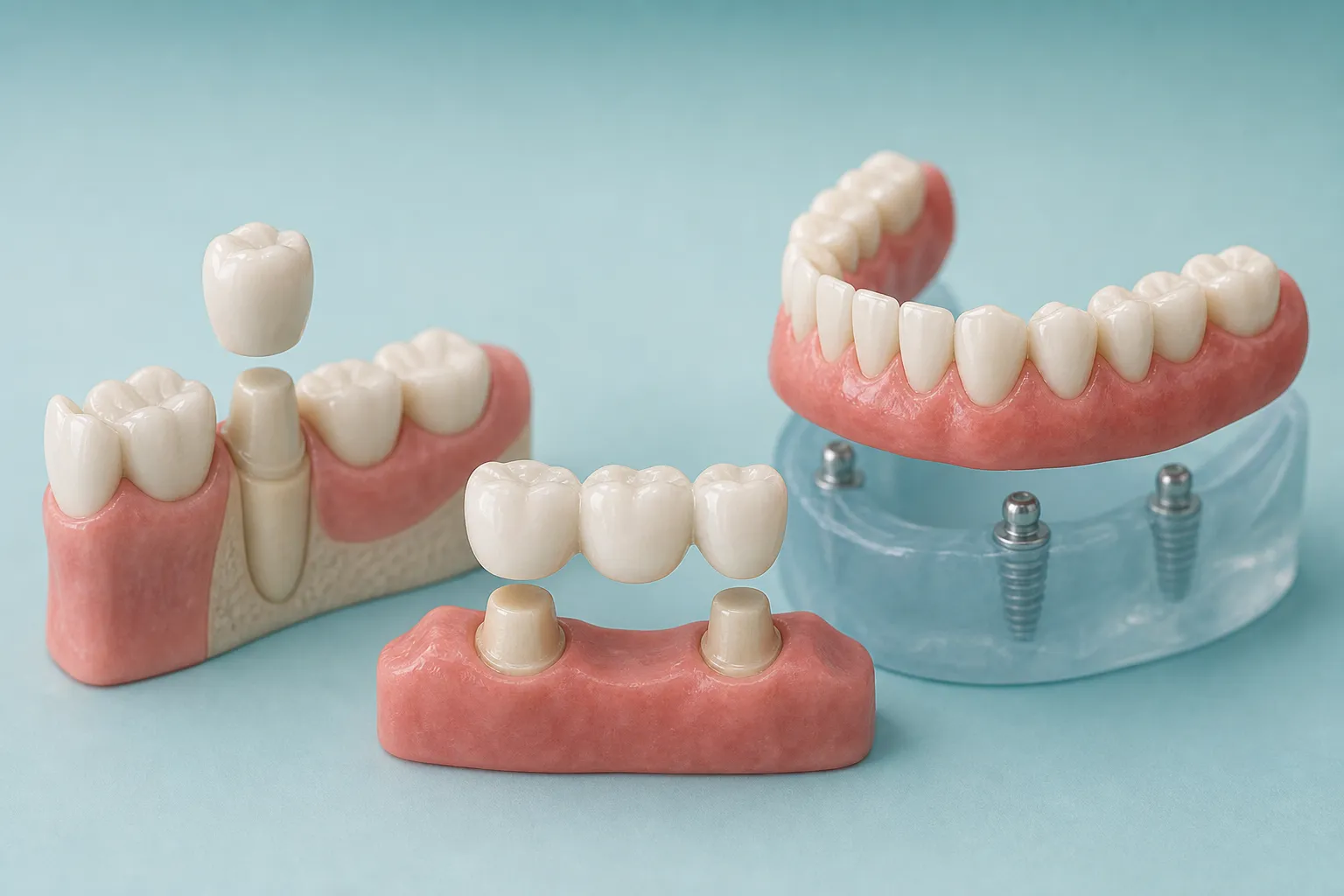
Losing a tooth usually forces a decision you will make only once. Three routes get put in front of you — an implant, a bridge, or a denture — plus a fourth once an entire arch is gone: an overdenture anchored on four implants. What separates them is not marketing. It is how much bone you have, whether the teeth beside the gap are already compromised, and what you can comfortably pay for without stalling treatment for two years.
Which tooth replacement option is right for me?
Short answer: For a single gap with healthy neighbors, a dental implant is the most conservative long-term choice because it replaces the root and leaves the adjacent teeth untouched. A bridge makes sense when those neighbors already need crowns. For a full arch, an overdenture on four implants balances stability and cost for most patients. A partial denture is a legitimate starting point when money or timing rules the others out.
The four routes, side by side
Every option below is the correct choice for somebody. The differences that actually matter are lifespan, whether your jawbone is protected, whether healthy tooth structure gets sacrificed, and what the whole thing costs across twenty years rather than this month.
| Option | Best for | Typical lifespan | Protects jawbone? | Main drawback |
|---|---|---|---|---|
| Dental implant | One or several missing teeth | Decades with good upkeep | Yes — replaces the root | Highest upfront cost; takes months |
| Fixed bridge | One gap with sound teeth either side | Commonly 10–15 years | No | Two healthy teeth are filed down permanently |
| Full or partial denture | Many or all teeth missing; tightest budget | Often 5–8 years before a remake | No — the ridge keeps shrinking | Movement, adhesive, much lower bite force |
| Overdenture on four implants | A whole arch, when stability matters | Implants: decades; the denture is remade periodically | Yes | Still lifts out — some patients want fixed |
Timelines differ as much as prices do. A bridge is usually finished in two or three visits over a few weeks. A conventional denture takes several appointments for impressions and fitting. An implant is the slow one: placement, then three to six months while bone fuses to the post, then the crown. Nobody walks around with a visible gap in the meantime — a temporary covers it — but you should plan around the calendar rather than be surprised by it.
If you are only weighing two of these, we go deeper in implants compared with bridges and in implants compared with dentures. The American Dental Association's consumer site, MouthHealthy, is a reasonable non-commercial second read.
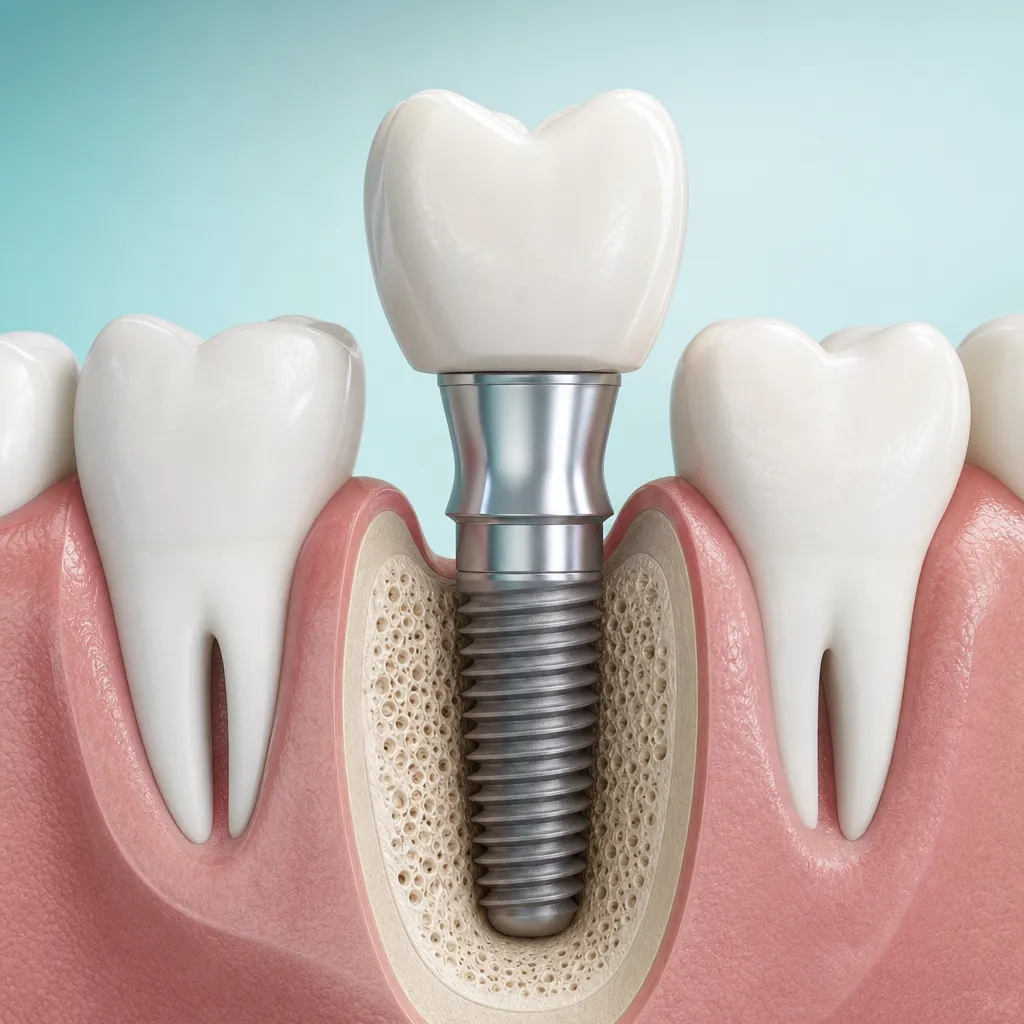
How many implants do you actually need?
Almost everyone assumes the arithmetic is one implant per missing tooth. It is not, and that misunderstanding is the single biggest reason people decide implants are out of reach before they ever ask.
| What is missing | Implants typically needed | What sits on top | The reasoning |
|---|---|---|---|
| One tooth | 1 | A single crown | One root replaced; the teeth either side are never touched |
| Two or three teeth in a row | 2 | An implant-supported bridge spanning the gap | Posts at each end carry the tooth or two between them |
| Scattered gaps, several healthy teeth left | 0–3, or none | Crowns, a short bridge, or a removable partial | Depends which gaps are wrecking your chewing and which are cosmetic |
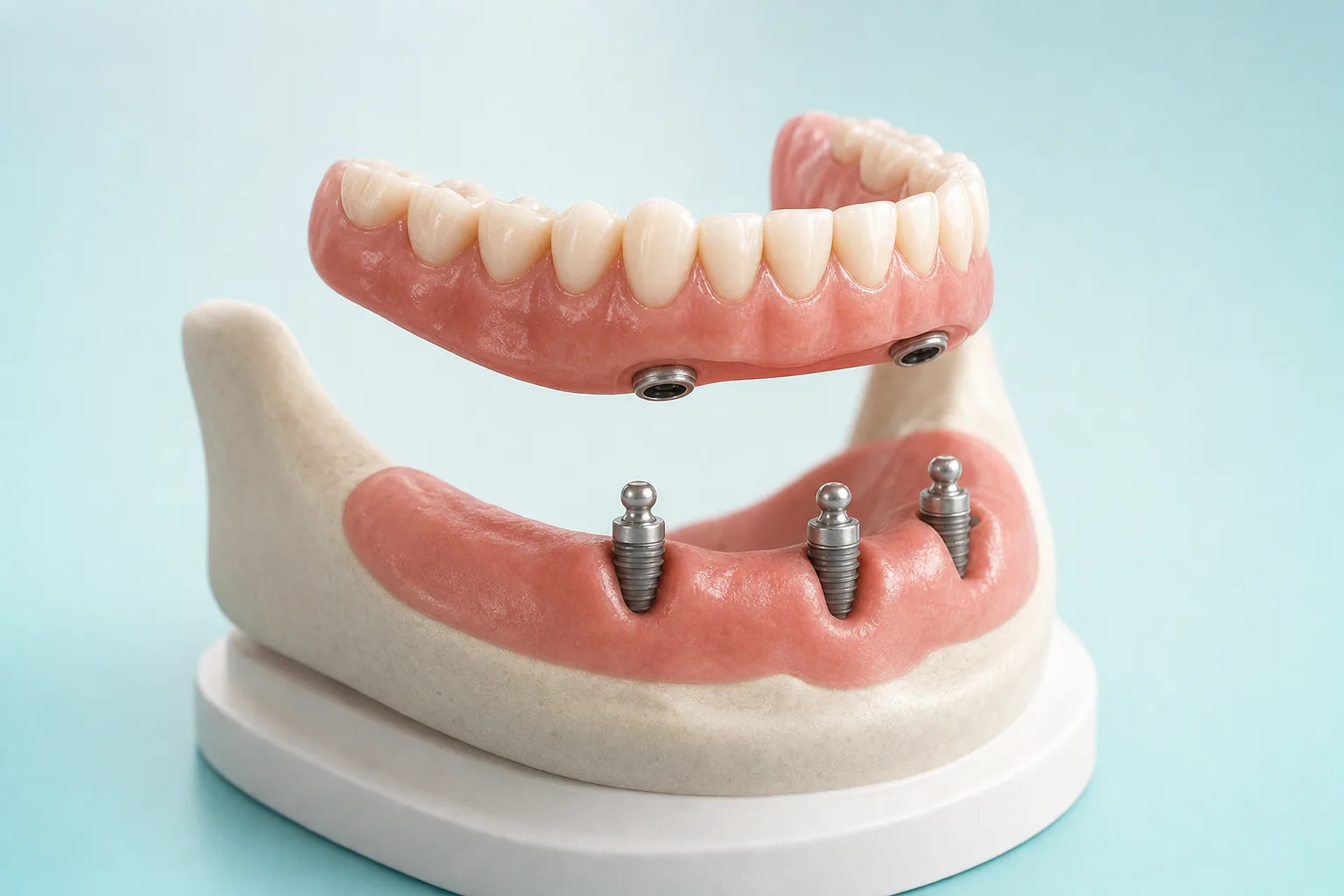
| A full arch — every tooth gone | 4 | A removable overdenture that snaps onto the posts | Support spread across four anchor points instead of twelve to fourteen roots |
That last row is worth reading twice. Restoring a full arch does not mean buying fourteen implants. Four posts hold a denture firmly enough that most patients go back to eating food they had quietly given up, and on an upper denture we can usually cut away the plate covering the roof of the mouth so taste and temperature return. The honest trade-off: it still lifts out at night for cleaning. Some people want something that never comes out, and we say so up front rather than after the fact. Implant-secured denture designs also vary in how much stability they deliver, so ask which one you are actually being quoted.
The part nobody explains: what happens to the bone
Jawbone is maintained by force travelling down a tooth root. Take the root away and the bone in that spot begins remodelling away, fastest during the first year. This is the quiet cost of leaving a gap alone, and it stays invisible until it starts limiting your choices.
Bridges and conventional dentures replace what you can see, not the root, so the ridge underneath keeps thinning. That is why dentures need relining every few years as the fit drifts, and why long-term denture wearers notice their lower face shortening. Implants — including the four under an overdenture — transmit load into bone and largely interrupt that process.
Two other things happen while you wait. Neighboring teeth tilt into the space, and the tooth opposite the gap slowly over-erupts because nothing meets it. Within a couple of years the bite has moved, the tilted tooth is harder to clean, and the eventual fix involves straightening that out first. A patient who waits five years sometimes needs bone grafting to get back the option they could have had for less at the start.
Front gaps and back gaps are different problems
Where the gap sits changes the calculation more than most people expect.
Front teeth are an appearance problem. The margin for error is small: gum shape, how light passes through the edge of a tooth, and how the tooth emerges from the gum all show. Implants do well here because they come out of the gum the way a natural tooth does rather than sitting on top of it. They also demand planning — a thin gum or a collapsed bone contour needs attention before anything is placed, not after.
Back teeth are a force problem. Molars do the heavy work, and this is where conventional dentures disappoint people. Bite force with a full denture is a fraction of what natural teeth deliver, which is why denture wearers quietly stop ordering steak and stop eating apples whole. If your missing teeth are molars and eating normally matters to you, implants or an implant-secured option deserve a serious look.
When a partial denture is the right first step
This is the path we recommend more often than the internet would suggest, and it is rarely described honestly.
If funds are tight right now, a well-made partial denture does three useful things: it restores chewing on that side, it keeps the neighboring teeth from drifting into the space, and it buys time to plan properly. Adult Denti-Cal benefits often cover full and partial dentures, subject to program rules and frequency limits — bring your card and we will verify exactly what you are eligible for before anything is scheduled. Our page on Denti-Cal and Medi-Cal coverage explains how we handle that.
Treat it as a stage, not a verdict. Go in clear-eyed about two things: a partial hooks onto the remaining teeth with clasps, and those teeth carry extra load, so they need watching. And a partial does not stop the ridge shrinking underneath it, so the longer the staged period runs, the more likely grafting becomes if you later move to implants. Neither is a reason to avoid a partial. Both are reasons to keep your checkups.
What actually drives the cost
Sticker comparisons mislead, because the number moves for reasons that have nothing to do with the implant itself:
- Groundwork before the main event. A failing tooth that still has to come out, a socket that needs grafting, a sinus sitting too low over an upper molar — each adds a step and a fee. See extractions and bone grafting.
- Whether the tooth can be saved at all. Sometimes the cheaper and better answer is not replacement — a root canal and a crown can keep a natural root working for years. We look at that first, not last.
- How many posts, and what goes over them. Four implants under one overdenture cost far less than rebuilding an arch tooth by tooth.
- Materials and lab work. A crown in the smile line is different work from a molar crown nobody sees.
- Sedation. Optional, and worth it for anxious patients — but it is a line item.
- Your benefit year. Most plans reset an annual maximum in January. Splitting a longer plan across two benefit years is a legitimate way to use more coverage, and we will map that out with you.
For a fuller breakdown of what shifts implant pricing and how PPO and HMO plans treat it, read our guide to implant costs and payment options. If cash flow is the obstacle rather than the plan itself, CareCredit, Cherry and Sunbit financing or our in-house membership plan often move things forward.
What can disqualify you — and what usually does not
Age, by itself, almost never rules implants out. These do change the picture:
- Uncontrolled diabetes and heavy smoking. Both meaningfully reduce implant success. Well-managed diabetes is a different conversation, and cutting back around the surgery genuinely helps.
- Active gum disease. Bone that is being lost around your own teeth will not reliably hold an implant. Treating the gums comes first — not as an upsell, as a prerequisite.
- Certain medications. Some osteoporosis drugs and cancer treatments change how bone heals. Bring your full medication list to the consultation; this is not something to leave off the form.
- Not enough bone. The most common "no" patients are handed, and often the most fixable. Grafting rebuilds a thin ridge, and in some cases an overdenture works with less bone than individual implants would demand. Get a 3-D scan before accepting that implants are impossible for you.
If an implant looks like a poor bet in your mouth, we will say so and offer the option that will hold up instead. Declining to place something costs you far less than replacing a failure.
What recovery actually feels like
For a single implant, most people describe it as easier than the extraction that preceded it. The site is numb during placement; the ache arrives that evening and is usually handled with over-the-counter pain relief. Swelling generally peaks around day two or three, then fades. Many patients are back at a desk job the next day. Soft food for roughly a week, no smoking, and no poking at the site.
Then comes the quiet part — three to six months of fusion where nothing seems to be happening and everything is. Full-arch treatment with extractions on the same day is a bigger event with a longer sore stretch, and we say so in advance. Our week-by-week implant healing guide walks through it in detail.
Get seen urgently if… you have facial swelling, swelling spreading toward your eye, jaw or neck, a fever alongside tooth pain, or any trouble swallowing or breathing. That is a spreading infection, not a wait-and-see problem — call us or go straight to emergency dental care the same day. A failing tooth left to abscess also destroys the bone you will need later.
Five questions worth asking before you commit
- What are all my options, including the ones you would not pick? A good answer includes the cheapest route and a clear reason it does or does not suit you.
- What happens to the bone under each option? This should not catch anyone off guard.
- Which of my healthy teeth get altered? A bridge costs you enamel that never comes back.
- What is the realistic lifespan, and what does plan B look like when it ends? Everything needs attention eventually.
- Can I see the whole cost in writing, with the part insurance will not cover separated out?
A practice that will not answer those plainly has told you something useful.
Getting a real answer for your own mouth
Three facts settle it: how much healthy bone you have, whether the teeth beside the gap are already compromised, and what you can comfortably fund. A consultation and 3-D scan answer the first two in about half an hour, and you leave with each workable option costed in writing — including the trade-offs, and the times the least expensive plan is genuinely the right one.
Bring your questions and your insurance card if you have one. Request a consultation with Dr. Sameer Aljanedi in Downey or call (562) 928-5559 — we welcome new patients, accept most PPO & HMO plans plus Denti-Cal and Medi-Cal, and se habla español.
FAQ
Frequently asked questions
Which tooth replacement option lasts the longest?
A dental implant. Because it replaces the root as well as the visible tooth, it does not depend on the neighboring teeth and it keeps loading the jawbone. With good home care and regular checkups, implants commonly last decades — longer than any other option.
Do I need one implant for every missing tooth?
No, and this is the most common misunderstanding. Two implants can carry a bridge replacing three teeth in a row, and a full arch is usually restored with a removable overdenture snapping onto four implants rather than one post per tooth.
What is the most affordable way to replace missing teeth?
A partial or full denture has the lowest upfront cost, with a bridge next. Implants cost the most at the start but are replaced far less often, so across twenty years the gap narrows considerably.
Does Denti-Cal cover replacing missing teeth?
Adult Denti-Cal benefits often include full and partial dentures, subject to program rules and frequency limits. Bring your card and we will verify exactly what you are eligible for before treatment is scheduled, then give you the costs in writing.
What happens if I just leave the gap?
Usually trouble. Adjacent teeth tilt into the space and the opposing tooth over-erupts, which changes your bite and makes later treatment harder and more expensive. The jawbone in that area also begins shrinking within months.
I was told I do not have enough bone for implants. Is that final?
Often not. Bone grafting rebuilds a thin ridge, and in some cases an overdenture on four implants works with less bone than individual implants would need. Get a 3-D scan before accepting that implants are off the table.
Which option is best if I am missing every tooth in one arch?
For most patients a removable overdenture secured by four implants is the sweet spot — far more stable than a conventional denture, much less costly than replacing every tooth individually, and it helps slow bone loss.
How do I decide?
Come in for a consultation and a 3-D scan. We will tell you which options your jaw can genuinely support, what each costs in writing, and the real trade-offs — including when the least expensive option is the right one.