Dentures & Implants
Snap-In Dentures vs. Regular Dentures: What's the Real Difference?
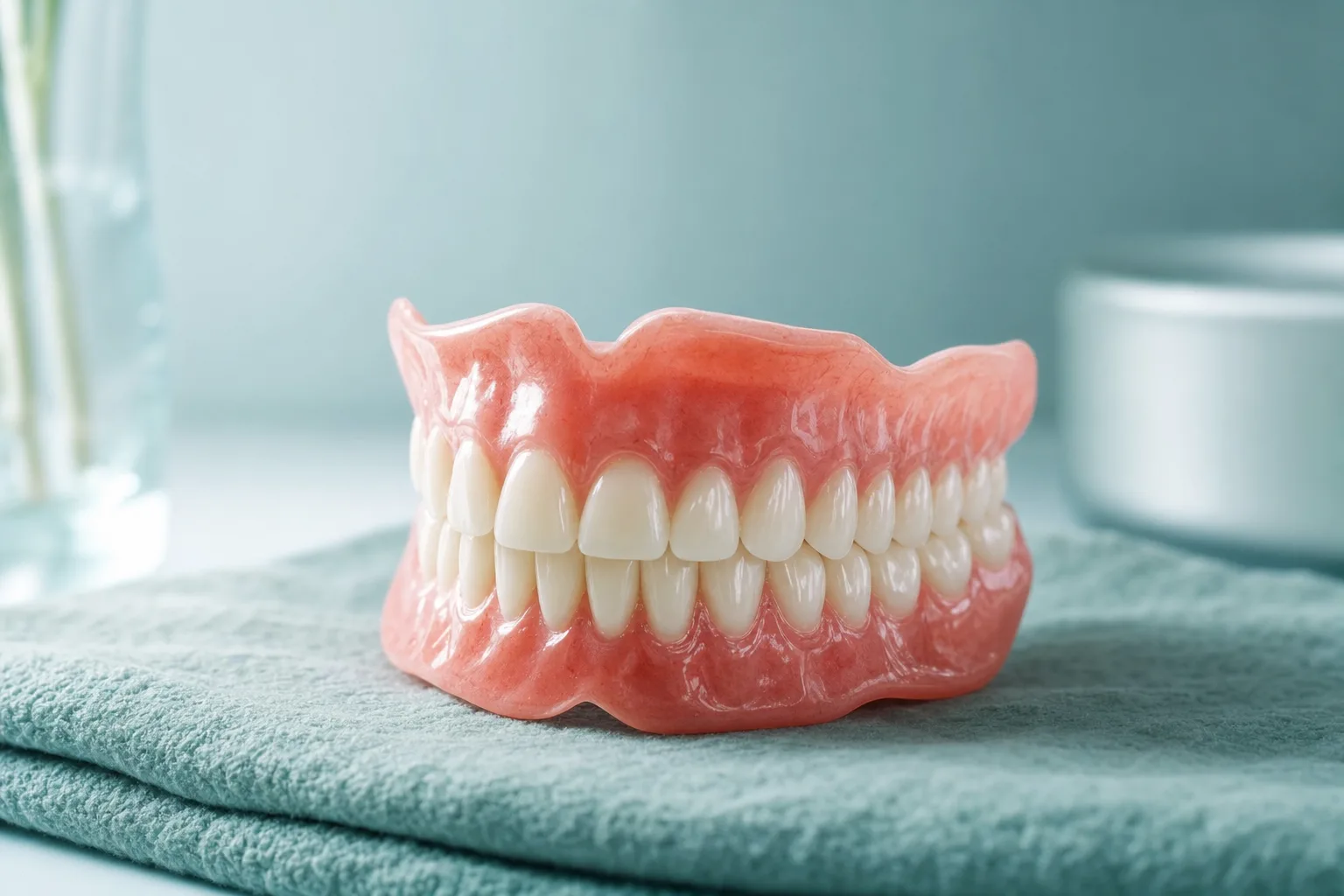
A regular denture rests on your gums and holds on by suction. A snap-in denture clips onto implants anchored in the jawbone. Resting on tissue versus anchoring into bone sounds like a small distinction, and it is not — it decides how hard you can bite, how often the appliance needs adjusting, and what the shape of your jaw looks like a decade from now.
Snap-in dentures vs. regular dentures: the short version
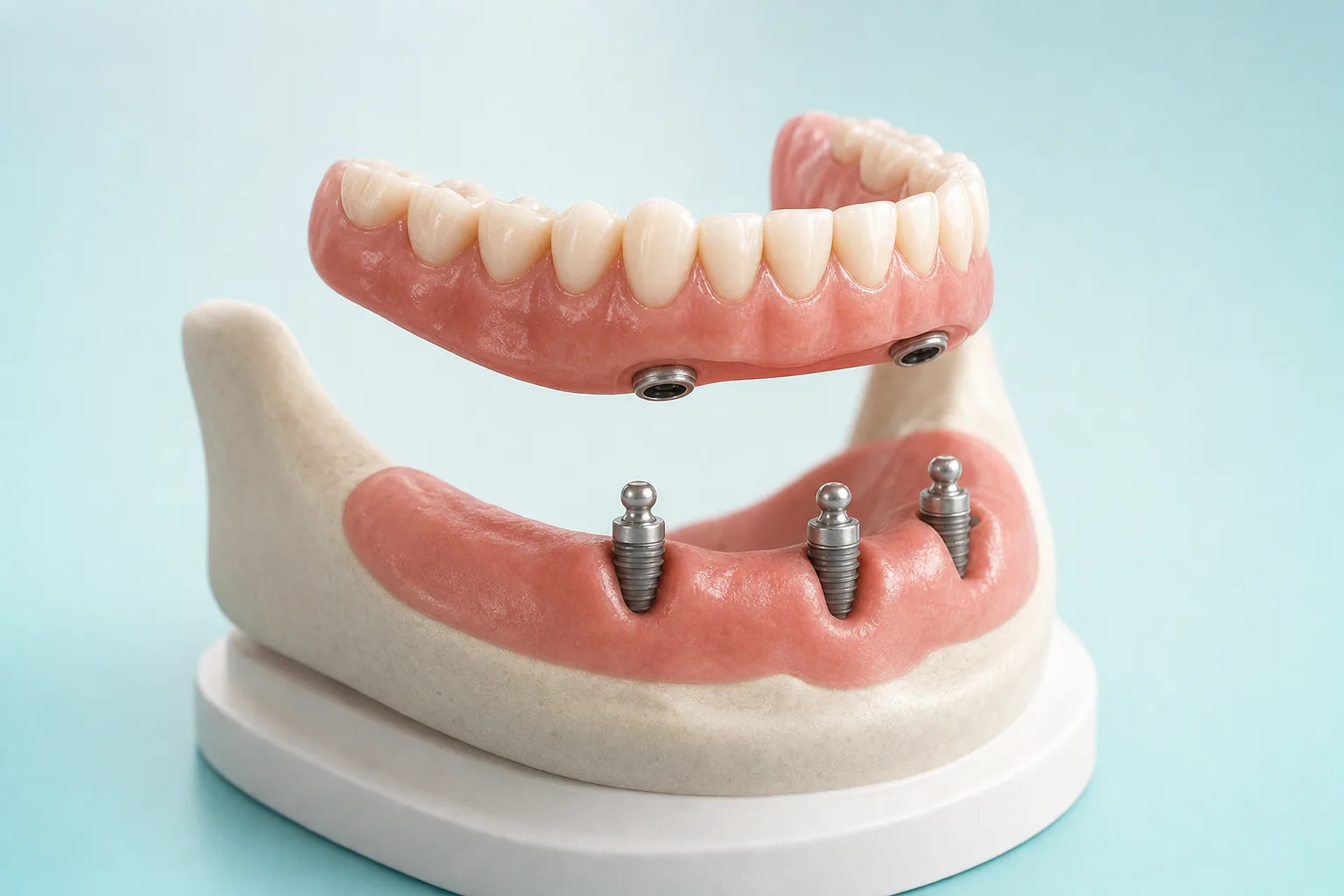
Short answer: A conventional denture sits on the gum ridge and depends on suction, adhesive and muscle control. A snap-in denture — clinically, an implant overdenture — carries attachments in its underside that click onto implants set in the jaw. It is dramatically more stable, restores far more chewing force, and preserves bone where the implants sit. It costs more up front and brings its own maintenance schedule.
Both are removable. Both come out at night. The difference is what holds them in during the day. At this office that second option takes one specific form: a removable overdenture anchored on four implants, which you lift out to clean and snap back in each morning.
What a snap-in denture actually is, and how it attaches
Three parts do the work. A titanium implant is placed in the jawbone and left to fuse with it over a healing period — that fusion, osseointegration, is what turns a screw into an anchor. On top of each implant sits an attachment, a small stud with a rounded undercut. Inside the denture, over each implant, sits a metal housing holding a replaceable nylon insert. Press down and the insert flexes over the undercut and grips. You hear a click. Lift the denture at the sides with your thumbnails and it releases.
Two attachment designs exist. Individual stud attachments give each implant its own connection and are the simpler, more common approach. A bar design splints the implants together with a cast bar and clips the denture onto it — sturdier in some situations, more expensive, and it needs more vertical room plus more diligent cleaning underneath. Which one suits you comes out of the scan and the shape of your ridge, not a preference stated in advance.
One habit worth learning on day one: never pull the denture out by the front teeth. Lift from the flanges on both sides at once. Levering it off from the front is how attachment housings work loose.
Why your regular dentures keep getting loose
This is the question patients ask most, usually with some frustration, because the denture fit beautifully the day it was delivered and now it drops when they laugh. Nothing went wrong with the denture. The jaw underneath it changed.
Natural tooth roots transmit chewing force into the surrounding bone, and bone maintains itself where it is loaded. Take the teeth out and the alveolar ridge — the horseshoe of bone that used to hold them — loses its job and begins to resorb. The steepest loss comes early. Commonly cited figures put roughly 30 to 60 percent of ridge width gone within the first six months after extraction, followed by a slower loss that continues, quietly, for the rest of your life. A denture does not slow that down; pressing on the ridge with every meal is generally thought to speed it up.
So the denture stays the same shape while the foundation it was molded to keeps shrinking away from it. That mismatch is what you feel as looseness. Lower dentures suffer worst — a small footprint, a tongue pushing at it, no palatal seal to help. The usual sequence is more adhesive, then thicker adhesive, then a reline to rebuild the fitting surface, then eventually a new denture. Relining is normal maintenance, not a sign anyone made a mistake.
Do implants actually slow bone loss under a denture?
Yes — locally, and that qualifier matters. An integrated implant loads the bone around it much the way a root does, and the bone responds by staying. Research on lower overdentures generally shows noticeably less resorption at the front of the jaw than in patients wearing conventional dentures over the same years.
Here is the part nobody puts on a service page: implants preserve bone in their own neighborhood, not across the whole arch. The ridge behind the last implant is still carrying denture load on soft tissue, and it keeps shrinking. Which means a snap-in denture still needs relining periodically. If someone tells you an overdenture is maintenance-free, they are selling, not explaining.
If your ridge has already thinned substantially — often the case after years in a full denture — a scan may show there is not enough height or width to place implants where they need to go. That does not end the conversation; it usually shifts it to rebuilding bone volume first, which adds months to the timeline before anything snaps into anything.
Side by side: conventional denture vs. implant overdenture
| Regular full denture | Snap-in denture on implants | |
|---|---|---|
| What holds it in | Suction, ridge anatomy, muscle control, adhesive | Attachments clipping onto implants in bone |
| Chewing force | A fraction of natural teeth; hard and chewy foods often stay off the plate for good | Substantially more; most patients get steak, apples and tortillas back |
| Upper palate | Plate covers the roof of the mouth for suction, which dulls taste and temperature | The plate can often be cut back or removed once implants carry the load |
| Movement while eating | Rocks and shifts; food traps underneath | Stays seated; some settling remains where the ridge is tissue-borne |
| Effect on the jawbone | Ridge keeps resorbing; facial support gradually collapses | Bone maintained around the implants; ridge behind them still changes |
| Surgery | None | Implant placement, plus grafting in some cases |
| Time to finish | Weeks | Months, driven by healing and integration |
| Up-front cost | Lowest of the full-arch options | Higher; implants, attachments and the denture are separate line items |
| What wears out | Fit surface, denture teeth, the acrylic itself | Nylon inserts first, then the same fit and wear issues over a longer horizon |
| Adhesive | Usually a daily consumable | Generally unnecessary |
Can my existing denture be converted to snap onto implants?
Often, yes — and it is one of the most useful questions you can put to a dentist, because converting is usually cheaper than starting over.
Your current denture has to pass a few tests first. The bite height and tooth position need to be right, since conversion locks in whatever is already there. The base has to fit the ridge reasonably well, or need only a reline to get there. And critically, the acrylic over each implant site has to be thick enough to accept a housing without being hollowed out to a wafer. A thin, heavily worn or previously fractured denture is a poor host — cut recesses into it and it can crack across the midline within months.
Two routes exist once it qualifies. Chairside pickup bonds the housings into the denture in a single visit, with you biting closed while the material sets. Lab processing sends it away for a day or two and generally produces a stronger, cleaner result. If the denture does not qualify, the honest answer is a new one built for the attachments from the start, and it is worth hearing that answer plainly rather than discovering it after a fracture.
The maintenance ledger both sides would rather skip
Comparison pages tend to list upkeep for the conventional denture and go quiet about the overdenture. Both have a schedule.
A conventional denture commonly needs relining every few years, and sooner during the first year after extractions when the ridge is changing fastest. Soft liners need renewing more often than hard ones. A complete remake typically arrives somewhere in the five-to-ten-year range, earlier if the teeth wear flat or the acrylic stains and crazes. Adhesive is an ongoing purchase. Drops onto a bathroom sink cause the repairs nobody budgets for.
A snap-in denture adds a wear part. The nylon inserts inside the housings lose grip and get swapped out — published replacement intervals conflict considerably, ranging from a few months to a couple of years, because the number depends on the attachment system, your bite force, and how often you take the appliance in and out. Expect it as a routine visit rather than a repair. Housings occasionally need re-bonding. Relines are still on the calendar for the reason described above. And the implants themselves need monitoring and professional cleaning like teeth do, because the gum around an implant can become inflamed and lose bone if plaque sits at the collar.
Nightly care is the same on both counts and is worth getting right: brush the appliance with a denture brush and a non-abrasive cleaner rather than regular toothpaste, keep it moist overnight, and skip hot water, which distorts acrylic. The American Dental Association's patient library at MouthHealthy covers denture care in more detail. With an overdenture, add one step nearly every guide omits: brush the attachment abutments themselves, at the gumline, every night. Cleaning the denture and ignoring what it clips onto is the most common maintenance failure we see.
Get seen promptly if… the gum around an implant is swollen, bleeds when brushed, or discharges; the denture suddenly rocks or one side stops clicking; a sore spot has not healed within about two weeks; a red or burning patch appears on the palate under an upper denture; or an implant feels loose. Facial swelling with fever, difficulty swallowing or difficulty breathing is an emergency room matter, not a Monday appointment.
When a snap-in denture is not the right first move
- Not enough bone yet. A 3-D scan settles this. Grafting is often the answer, but it means additional healing time before implants go in.
- Uncontrolled medical conditions or heavy smoking. Both raise the risk that an implant fails to integrate. Neither is automatically disqualifying; both change the conversation.
- Certain bone medications or a history of head and neck radiation. These require coordination with your physician before anything is planned.
- Limited hand strength or dexterity. Seating and removing an overdenture takes a certain grip. Arthritic hands sometimes do better with a different design, and that is worth testing rather than assuming.
- Timing and budget. A well-made conventional denture now, with implants added later, is a legitimate staged plan rather than a compromise — and CareCredit, Cherry and Sunbit exist to spread the second stage.
If you still have some natural teeth in the arch, the comparison above may not be the right one at all. Partial dentures, bridges and single implants change the calculation, and our overview of ways to replace missing teeth lays those out.
Five questions worth asking at the consultation
- How many implants, and why that number for my jaw? The answer should reference your scan, not a package.
- Stud attachments or a bar, and what made you choose it?
- Does the quote include the denture itself, or only the surgical phase? This is where two estimates that look different usually turn out to be measuring different things.
- How often will the inserts need replacing, and what does that visit involve?
- Do I need grafting, and does the timeline you gave me include that healing?
Answers to those five tell you more about a treatment plan than any price comparison will.
Find out which one your jaw can support
If your lower denture has started travelling at dinner, a scan and a conversation with Dr. Sameer Aljanedi will show whether your ridge can carry implants now, needs grafting first, or is better served by relining what you already wear. Our Downey team is bilingual and se habla español — request a consultation or call (562) 928-5559.
Have questions about your smile?
Dr. Sameer Aljanedi and the team at Rio Hondo Dental Office are here to help. Se habla español.