Restorative Dentistry
Signs You Need a Root Canal (and Signs You Don't)
The detail that matters most is not how badly it hurts. It is how long the pain lasts after the trigger goes away.
A tooth that zings on cold and settles in two or three seconds is usually reporting exposed dentin. A tooth still aching thirty seconds after the ice water is gone is reporting something else entirely — a nerve inflamed past the point of recovery. Same glass of water, same patient, completely different treatment.
How do I know if I need a root canal?
Short answer: The nerve inside a tooth is usually damaged beyond healing when cold or hot pain lingers longer than roughly 30 seconds, when pain starts with no trigger or wakes you at night, when a pimple-like bump appears on the gum, or when a tooth darkens on its own. A dentist confirms it with cold testing, tapping and an X-ray. Symptoms point; tests decide.
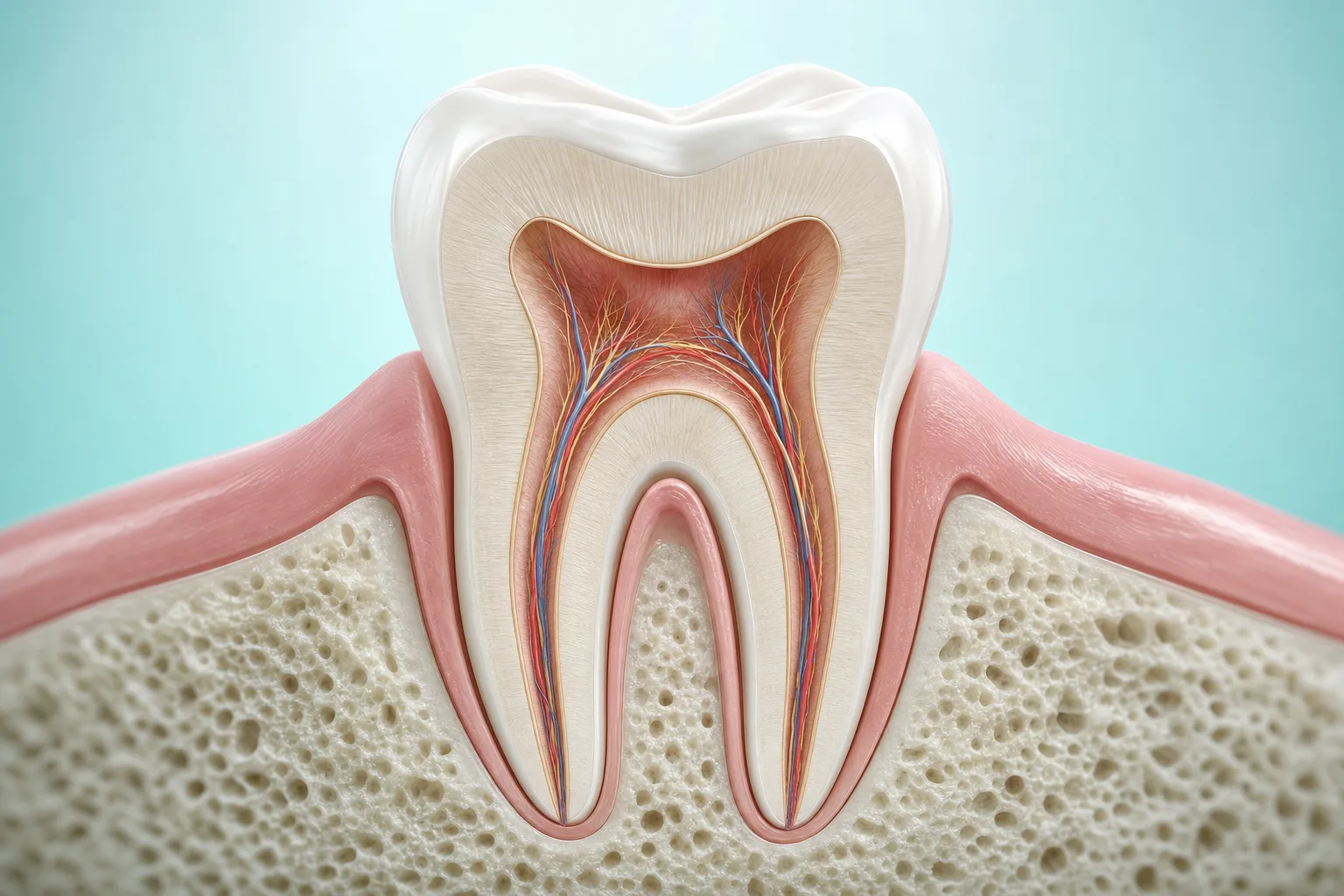
The pulp is the soft tissue in the middle of a tooth — nerve, blood vessels, connective tissue — sealed inside a hard chamber with nowhere to swell. When bacteria from a deep cavity, a crack or a failing old filling reach it, the pressure of that inflammation strangles its own blood supply and the tissue dies. Root canal treatment removes the dead or dying tissue, disinfects the canals and seals them. Nothing reverses a pulp that has crossed that line. No rinse, no toothpaste, no course of pills.
Symptom by symptom: what each pattern usually means
Read this the way your dentist does — by pattern, not by intensity. Some of the worst pain in dentistry comes from a tooth that can be saved with a filling, and some of the quietest teeth are already dead.
| What you are feeling | What it usually means | Typical next step |
|---|---|---|
| Sharp zing to cold that stops within a few seconds | The nerve is alive and reacting normally — often gum recession, a worn spot, or a recent filling settling | Desensitizing agent, bite check, or a filling; watch it |
| Cold pain that lingers 30 seconds to several minutes | Irreversible pulpitis — the nerve is inflamed and will not recover | Root canal treatment, occasionally extraction |
| Pain that starts on its own, or wakes you at 2 a.m. | Irreversible pulpitis, usually well advanced | Root canal treatment |
| Hot drinks hurt; holding cold water in your mouth relieves it | A dying or dead pulp with pressure building inside the canal | Root canal treatment, generally without delay |
| Pain on releasing a bite rather than clamping down | A cracked tooth flexing under load | Crown or onlay; root canal too if the crack has reached the pulp |
| Dull constant ache, tooth feels tall or tender to tap | Infection has spread past the root tip into the surrounding bone | Root canal or extraction; urgent if the face is swelling |
| A pimple on the gum that drains, then the pain stops | A chronic abscess venting through a sinus tract — still fully active | Root canal or extraction. The tooth has not healed |
| A single tooth turning grey or brown years after a knock | The pulp died quietly after the trauma | Root canal, then internal bleaching or a crown |
| No symptoms at all; a dark shadow at the root tip on an X-ray | Asymptomatic apical periodontitis — a silent infection in bone | Root canal or extraction, planned rather than rushed |
Does lingering cold sensitivity mean the nerve is dying?
Often, yes — and duration is the test you can run yourself. Take a sip of ice water, hold it against the suspect tooth, then spit and count. Under about ten seconds and the pulp is very likely healthy. Past thirty seconds, or if the ache builds after the cold is gone rather than fading, the diagnosis shifts hard toward irreversible pulpitis. Dentists use a refrigerant spray on a cotton pellet to do the same test more precisely, comparing the suspect tooth against its neighbours and the matching tooth on the other side.
Two extra clues carry real weight. Pain you cannot localize — you know it is the upper left but cannot say which tooth — is typical of pulp inflammation, because the pulp has no ability to tell your brain where it is. Once the tooth becomes tender to tapping and you can point straight at it, the problem has moved out of the pulp and into the bone around the root tip. That transition usually means the tooth has gone from inflamed to infected.
Is a pimple on my gum a sign of infection?
Almost always. That bump is a parulis, the surface opening of a channel draining pus from an abscess at the tip of a root. Patients frequently report that it appeared, the tooth stopped hurting, and they assumed the problem passed.
The opposite happened. Pain stops precisely because the pressure now has an escape route. The infection continues eating bone around the root tip while feeling like nothing at all, sometimes for years, and the bump often shrinks and returns in cycles. A draining sinus tract is not a resolved infection. It is a stable one, and stable is not the same as safe.
Can a tooth need a root canal without hurting at all?
Yes, and this catches people badly off guard. A pulp can die slowly enough that the inflammatory stage passes unnoticed — common after an old sports injury, under a large filling placed decades ago, or in a tooth that hurt once for a week years back and then went quiet. Dying is painful. Being dead usually is not.
What shows up instead is a dark circle at the root tip on a routine X-ray, where infection has dissolved bone. The tooth may test stone dead to cold while looking perfect. This is one of the plainer arguments for keeping up with periodic radiographs at your checkups: silent lesions are found on film or not at all, and a tooth caught this way is usually straightforward to treat compared to the same tooth found six months later during a swelling.
Symptoms that look like a root canal but usually are not
Plenty of tooth pain has nothing to do with the nerve inside the tooth. Before assuming the worst, rule these out:
- Generalized cold sensitivity across several teeth. Multiple teeth reacting at once points to recession, enamel wear, aggressive brushing or grinding — not a single dying pulp. Nerve problems are almost always one tooth.
- A new filling that has been sensitive for two weeks. Mild cold sensitivity after a deep filling is common and frequently settles over several weeks. If it is worsening, or has started keeping you awake, that is a different conversation.
- Pain that hits on the first bite and then eases. Often a filling or crown sitting a hair too high. Adjusting the bite takes minutes.
- Aching in several upper back teeth during allergy season, worse when you bend forward. That is sinus pressure on root tips, not pulpitis. Upper molar roots sit close to the sinus floor.
- Soreness along the gumline with bleeding. Gum inflammation and periodontal problems produce their own pain and their own treatment path.
- Sensitivity after whitening. Uncomfortable, temporary, unrelated to the pulp dying.
Pain on biting is the pattern most likely to be misread in either direction, because a crack, a high restoration and an abscessed root tip can all produce it. Our longer piece on pain that appears when you bite down works through how those are told apart.
Will antibiotics clear it up instead?
Not on their own, and this is worth being blunt about because so many people try it first.
Antibiotics travel through the bloodstream. A tooth with a dead pulp has no blood supply left inside the canal system, so the drug never reaches the bacteria living there. What antibiotics can do is knock back a spreading infection in the surrounding tissue, which is why swelling improves for a few days and then comes back once the course ends. The source is still sitting inside the tooth.
This is not just clinical opinion. The American Dental Association's 2019 clinical practice guideline on antibiotic use for pulpal and periapical conditions concluded that healthy adults with symptomatic irreversible pulpitis, pulp necrosis with symptomatic apical periodontitis, or a localized acute apical abscess should receive definitive dental treatment — opening the tooth, or removing it — rather than antibiotics. Antibiotics belong alongside that treatment when infection has spread beyond the local area or the patient shows systemic signs such as fever, malaise or swollen lymph nodes, or when urgent dental care genuinely cannot be delivered right away. You can read the ADA's guidance for patients and clinicians directly.
Practical translation: a prescription is a bridge, not a destination. If you have been through two rounds and the tooth keeps flaring, the tooth itself has never been treated.
Get seen urgently if… your face, jaw or under-eye area is swelling, you have a fever alongside tooth pain, the pain is severe enough to defeat over-the-counter medication, or you cannot bite without the tooth screaming. Go to an emergency room immediately — not to a dental office — if swelling is spreading toward the eye or down the neck, if you have trouble swallowing or breathing, or if you cannot open your mouth fully. Those signs suggest infection moving into spaces where it becomes dangerous fast. Our urgent dental care page covers what to do before you are seen.
When a tooth cannot be saved
Root canal treatment is not automatically available. A few findings take it off the table, and an honest dentist tells you before you have paid for anything:
- A vertical root fracture. A crack running lengthwise down the root cannot be sealed. Prognosis is poor and removing the tooth is usually the only real option.
- Not enough tooth above the gum. A final restoration needs a collar of solid structure to grip. When decay has run below the bone level, there may be nothing left to build on.
- Advanced bone loss from gum disease. A perfectly treated root inside a tooth that is already loose buys very little.
- Canals too calcified to navigate. Older teeth sometimes wall off their own canals. A specialist with a microscope can often get through where a general dentist cannot, which is one reason referrals happen.
Cost tracks the anatomy more than anything else. A front tooth typically has one canal; a molar commonly has three or four, sometimes an extra hidden one, and takes far longer. Retreating a tooth that had a root canal years ago costs more than doing it the first time, because the old filling material has to come out first. And the number most patients underestimate is the restoration afterward — a treated back tooth nearly always needs a crown over it to keep from splitting, and that is a separate procedure with its own fee and its own insurance category. Ask for both numbers together. A quote for the root canal alone is only half the plan.
What treatment and recovery actually feel like
The reputation is decades out of date. With profound local anesthesia, the appointment itself feels much like having a deep filling — pressure, the sound of the handpiece, a rubber dam isolating the tooth, and 60 to 90 minutes of holding your mouth open. The pain people associate with root canals is the pain of the abscess that sent them in.
- The day of. Numbness for two to four hours. Do not chew until it wears off — a numb lip is easy to bite. Take ibuprofen before the anesthetic fades rather than after, if it suits your medical history.
- Days one to three. The tooth is commonly tender to bite on, sometimes noticeably. This is inflammation in the ligament around the root, not failure. Chew on the other side.
- Days four to seven. Tenderness fades for most people. A tooth still sore at a week, or getting worse, warrants a call rather than waiting.
- Weeks two onward. The tooth should feel unremarkable. If the plan calls for a crown, get it done — a temporary filling is not a seal, and leaving one in place for months lets bacteria back down the canals.
A small percentage of cases flare up in the first few days with real swelling and throbbing. It is manageable and it is not a sign the treatment failed, but it needs to be reported, not endured. Our post-treatment recovery checklist spells out what is normal and what is not.
What happens if you wait
Waiting rarely produces a dramatic emergency on day one. What it does is narrow your options quietly. An inflamed pulp becomes a dead one. A dead pulp becomes an infection at the root tip. That infection dissolves bone around the root, and the lesion visible on the X-ray grows.
Three things get worse in that window. The tooth becomes more likely to be non-restorable, because decay keeps advancing while you decide. Bone dissolved around the root tip has to regenerate after treatment, which takes months and does not always come back fully. And the odds of an acute episode — the kind with facial swelling that lands people in an emergency room over a holiday weekend — climb the longer an untreated infection sits there. Saving a tooth also tends to cost less than losing it, since replacing an extracted tooth means an implant or a bridge on top of the extraction fee.
What to ask before you agree to anything
- What did the cold test show, and how did this tooth compare to its neighbours? A specific answer means testing actually happened.
- Is there a lesion at the root tip on the X-ray, and how large? Ask to see the film. Dark circles at root tips are visible to anyone once pointed out.
- Is this tooth restorable after treatment, and what will it need? Root canal plus crown is the usual full picture.
- What is the prognosis, honestly, and what would make you recommend extraction instead?
- What does this cost together, and what does my plan cover? Root canals and crowns often fall in different benefit categories with different waiting periods.
If you want to see how the procedure is handled here first, our page on endodontic care and root canal therapy walks through it step by step.
Get the tooth looked at while you still have choices
If cold pain is hanging around, something is throbbing at night, or a bump keeps appearing on your gum, Dr. Sameer Aljanedi will test the tooth, show you the X-ray and tell you plainly whether the nerve is savable. Our Downey team is bilingual, se habla español, and we accept most PPO and HMO plans along with Denti-Cal and Medi-Cal. Book a visit or call (562) 928-5559.
Have questions about your smile?
Dr. Sameer Aljanedi and the team at Rio Hondo Dental Office are here to help. Se habla español.